
Building Change Capability: New McLean & Company Blueprint for HR Leaders
A recently published resource from McLean & Company helps HR leaders assess whether a change management office fits their organization. For organizations moving forward, it provides guidance on defining the office’s purpose, governance, operating model, and measures of success.
TORONTO, Nov. 5, 2026 /CNW/ — According to global HR research and advisory firm McLean & Company’s HR Trends Report 2026, 70% of organizations report challenges managing change, with too many concurrent initiatives identified as the leading cause. When change is managed separately by projects and functions, leaders lack a coordinated view of the demands placed on employees. Employees must then navigate overlapping initiatives, inconsistent communication, and unclear priorities, making accountability and adoption harder to sustain. An HR-led change management office (CMO) can provide structure and governance that connect these efforts to organizational priorities. McLean & Company’s new blueprint, Establish a Change Management Office, helps HR leaders determine whether a CMO is needed and how to build one effectively.
McLean & Company’s blueprint identifies a lack of enterprise visibility as a barrier to managing change, especially when several changes reach employees at once. Without a consolidated view across projects and functions, leaders cannot assess the total demand on employees, understand how initiatives compete for attention, or see their combined impact.
“Change does not break down because organizations lack plans or processes. It breaks down when teams approach change inconsistently across the organization, leading to conflicting messages and competing priorities that undermine the employee experience,” says Amani Gharib, HR research & advisory services director at McLean & Company. “An HR-led CMO establishes a consistent approach to change, clarifies decision rights, and ensures leaders are aligned in how change is planned, communicated, implemented, and sustained across the organization.”
The firm’s research also found that just 19% of leaders are highly effective at change management, reinforcing the need for a coordinated HR role in helping organizations navigate change.
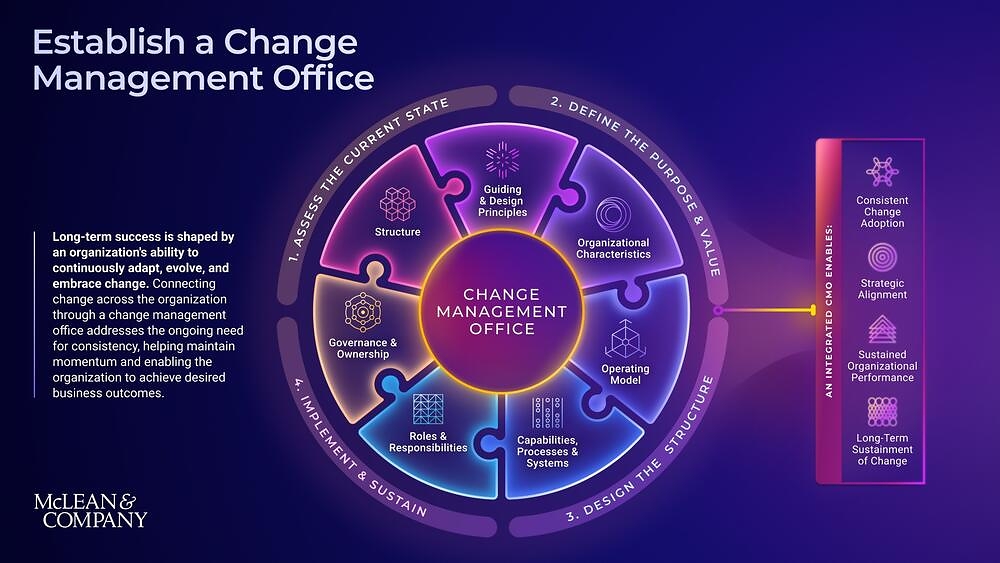
In response to that need, McLean & Company’s Establish a Change Management Office blueprint outlines a four-step process that moves from assessing the organization’s current state and confirming the need for a CMO to designing, implementing, and sustaining the function:
- Assess the current state. Evaluate existing change practices, strengths, gaps, and HR’s role in enabling change to determine whether a more coordinated model is needed.
- Define the need, purpose, and value of the CMO. Establish the problem the CMO will solve, articulate its purpose and expected value, define goals and measures, and secure executive commitment.
- Design the CMO operating model and structure. Define the capabilities, processes, and systems the CMO requires, then establish roles, responsibilities, governance, and decision ownership.
- Implement and sustain the CMO. Select a rollout approach, communicate the change, launch the function, and monitor results to strengthen adoption and refine the CMO over time.
McLean & Company cautions that a CMO is not a default solution for every organization. HR leaders should move forward only when there is a defined problem to solve, visible leadership commitment, gaps in existing governance, and sufficient organizational readiness to prioritize change. If those conditions are not in place, strengthening foundational change enablement practices should come first.
To access the full blueprint, visit McLean & Company’s Establish a Change Management Office page.
For related support, HR leaders can explore McLean & Company’s Develop an Effective Change Management Plan workshop or the firm’s Change Management Resource Center.
Media seeking research-backed insights or commentary from McLean & Company experts on change management, HR-led transformation, change governance, organizational effectiveness, or employee adoption can contact [email protected].
About McLean & Company
McLean & Company is a global HR research and advisory firm and trusted partner to people leaders navigating today’s most pressing workforce challenges. Informed by its work with thousands of HR professionals and executives, the firm provides evidence-based research, diagnostics, practical tools, hands-on support, and services spanning advisory, learning, and coaching. From workforce strategy and leadership to culture, engagement, retention, and AI adoption, McLean & Company helps leaders move from direction to execution and deliver measurable results for their people and organizations.
McLean & Company is a division of Infotech.
Media professionals can register for unrestricted access to research across IT, HR, and software, and hundreds of industry analysts through the firm’s Media Insiders program. To gain access, contact [email protected].
 View original content to download multimedia:https://www.prnewswire.com/news-releases/building-change-capability-new-mclean–company-blueprint-for-hr-leaders-302927974.html
SOURCE McLean & Company
