
ARRAS MINERALS FURTHER DEFINES 2.5 KM AND 3.5 KM COPPER-GOLD TARGETS ALONG BEREZSKI PORPHYRY TREND & APPOINTS DR. FARHAD BOUZARI AS PRINCIPAL GEOSCIENTIST
TSX-V: ARK / OTCQB: ARRKF
VANCOUVER, BC, Sept. 21, 2026 /CNW/ — Arras Minerals Corp. (TSXV: ARK) (OTCQB: ARRKF) (“Arras” or the “Company”) is pleased to announce results from its top-of-bedrock (“KGK”) drilling program across the Berezski Trend at the Elemes Project in northeastern Kazakhstan. The new results materially expand the geochemical footprint of the Berezski mineralizing system and define two large, untested target corridors extending approximately 2.5 kilometres north from the Berezski Central and approximately 3.5 kilometres north from the Berezski East deposits. The Company is also pleased to announce the appointment of Dr. Farhad Bouzari as Principal Geoscientist.
Key Highlights:
Two large, untested KGK targets have been defined by gold and copper geochemistry from KGK drilling extending approximately 2.5 km north from the Berezski Central and approximately 3.5 km north from the Berezski East deposits.
- The strongest KGK gold responses show a close spatial relationship with pronounced magnetic lows. Arras interprets these magnetic lows as zones of hydrothermal alteration and considers the coincident gold response to be an important vector toward concealed porphyry and related mineralization beneath shallow cover.
- The new anomalies form a clear northerly continuation of the same mineralizing trend already demonstrated by diamond drilling at Berezski Central, Berezski East and Berezski North, providing substantial undrilled exploration potential along the Berezski Trend.
Additional targets identified within these areas include:
- A 1.0 km x 0.4 km coincident Cu-Au anomaly approximately 2 km north of Berezski Central, within a broader 2.5 km north-trending target corridor toward Berezski North.
- A 0.5 km x 0.3 km Cu-Au anomaly north of Berezski East, forming part of the broader 3.5 km north-trending target corridor.
- A 1.1 km x 0.3 km continuous gold anomaly immediately east of Berezski East that coincides with a strong magnetic-low feature and represents an additional untested target.
Tim Barry, CEO of Arras Minerals, commented, “These KGK results significantly increase the scale of the Berezski system as we currently understand it. Most importantly, the gold geochemistry outlines two large undrilled corridors extending approximately 2.5 kilometres north of Berezski Central and approximately 3.5 kilometres north of Berezski East. Both corridors are closely associated with prominent magnetic lows that we interpret to represent hydrothermal alteration. The geometry of these anomalies provides compelling evidence of a continuation of the mineralizing trend already demonstrated by drilling at Berezski Central, Berezski East and Berezski North.“
Mr. Barry continued, “KGK samples only the uppermost bedrock beneath the shallow cover. In this weathered environment, copper responses can be subdued where copper has been leached from the near-surface part of the system, whereas gold can remain as a more persistent indicator of the underlying mineralizing system. This makes the strong gold response, particularly where it coincides with magnetic lows, an important exploration vector at Elemes. Despite the subdued near-surface copper response, values remain locally elevated above 500 ppm and in places approach 1% Cu, supporting the interpretation that copper-bearing mineralization continues within these largely untested trends.”
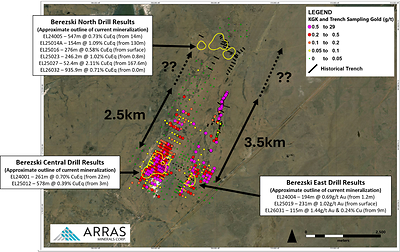
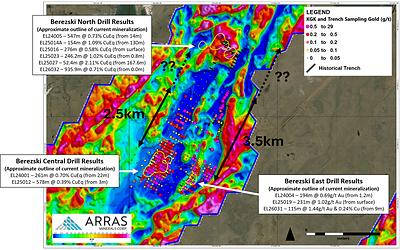
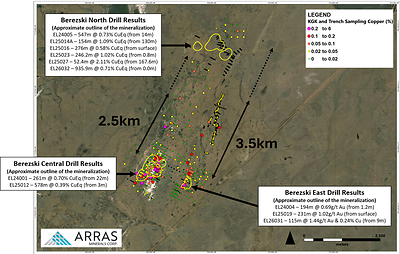
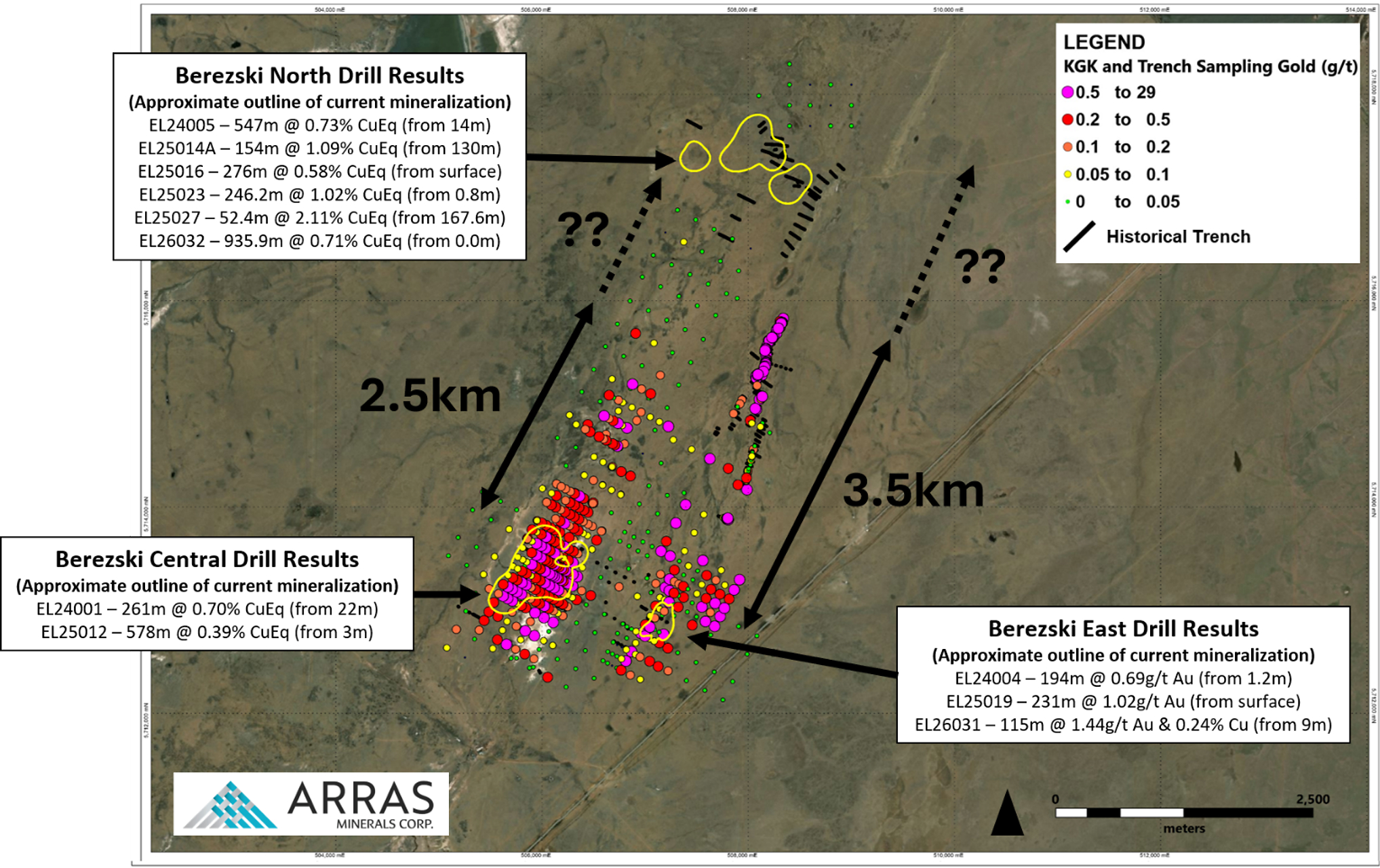
Top-of-Bedrock (KGK) Drilling at Berezski Trend: The KGK program was designed to sample the top of bedrock beneath the shallow, transported cover that masks much of the Berezski Trend. The results received to date have defined several broad, coherent gold, copper and molybdenum responses around the known Berezski Central and Berezski East deposits that, importantly, extend well beyond the limits of current diamond drilling.
The significance of these new undrilled corridors is reinforced by the diamond drilling results already returned from the same Berezski mineralizing trend. Selected results shown on the accompanying maps include:
- 261 m at 0.70% CuEq from 22m in EL24001 at Berezski Central,
- 115 m at 1.44 g/t Au and 0.24% Cu from 9m in EL26031 at Berezski East, and
- 935.9 m at 0.71% CuEq from surface in EL26032 at Berezski North.
These drilled centres provide important geological context for the new KGK anomalies that remain largely untested by diamond drilling.
Berezski Central KGK Target: Gold anomalism extends approximately 2.5 km north of Berezski Central toward Berezski North. The anomaly follows a broad magnetic low and contains a 1.0 km x 0.4 km coincident Cu-Au anomaly approximately 2 km north of Berezski Central. Arras interprets the combination of gold geochemistry, locally elevated copper and molybdenum, and the magnetic-low response as evidence of a continuous, hydrothermally altered and mineralized corridor beneath shallow cover.
Berezski East KGK Target: Gold anomalism extends approximately 3.5 km north of Berezski East, defining a substantial and largely undrilled exploration corridor that includes a 0.5 km x 0.3 km coincident Cu-Au anomaly. The trend is spatially associated with a pronounced magnetic low and is interpreted as a possible continuation of the hydrothermal system that hosts Berezski East. Immediately east of the current drilling area, a separate 1.1 km x 0.3 km continuous gold anomaly also coincides with a strong magnetic-low feature, providing an additional untested target adjacent to the known mineralized footprint.
Appointment of Dr. Farhad Bouzari: Dr. Bouzari has been appointed as Principal Geoscientist and will work closely with the Arras technical team across the Company’s copper-gold exploration portfolio in Kazakhstan. Mr. Bouzari is an economic geologist with more than 25 years of international experience specializing in the exploration, characterization and geological interpretation of porphyry copper-gold and related magmatic-hydrothermal systems.
Dr. Bouzari holds M.Sc. and Ph.D. degrees from Queen’s University in Ontario and spent nearly two decades as a senior researcher with the Mineral Deposit Research Unit (MDRU) at the University of British Columbia, where his work focused extensively on understanding the geological, alteration, geochemical and structural characteristics of porphyry systems around the world. His career has included the study and evaluation of numerous porphyry districts across a wide range of geological environments, giving him extensive experience identifying the key features used to vector toward concealed and mineralized porphyry centres.
Importantly for Arras, Dr. Bouzari also brings experience working on porphyry systems in Central Asia and the surrounding region, including projects in Kazakhstan and Iran. This regional experience, combined with his extensive global work on porphyry exploration and system characterization, is expected to provide valuable additional expertise as Arras continues to define and interpret multiple porphyry centres and advance emerging exploration targets across its Kazakhstan portfolio.
Exploration Update: Four diamond drill rigs are currently operating at Elemes. To date, 30 holes have been completed, and more than 31,000 metres have been drilled. KGK assay results remain pending from the area north of Berezski North and from the Aimandai Trend, located approximately 7 km east of the Berezski Trend. These outstanding results will provide additional coverage across areas that remain lightly tested or undrilled beneath shallow cover.
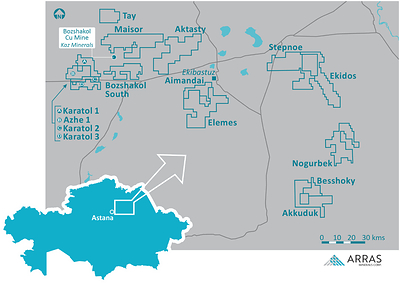
Elemes Project Overview: The Elemes Project comprises two exploration licences covering 531 square kilometres in northeastern Kazakhstan, approximately 13 km southwest of Ekibastuz and about 20 km from Arras’s operational base. The project benefits from established infrastructure, including a paved highway crossing the licence area and access to power, heavy rail and other utilities within approximately 15 km.
Situated within the prolific Bozshakol-Chingiz metallogenic belt, Elemes lies near significant regional deposits, including the Beskauga porphyry copper-gold-silver deposit (~80 km east) and KAZ Minerals’ Bozshakol copper-gold mine (~60 km northwest), which reported mined grades in Q1 2025 of 0.37% copper and 0.20 g/t gold. 1
Geologically, the property is underlain by interbedded intermediate volcanic and sedimentary rocks intruded by multiple phases of diorite and monzodiorite porphyry. Copper-gold mineralization occurs in sheeted and stockwork quartz-chalcopyrite veins associated with these intrusions. High-grade low-sulphidation epithermal veins have also been mapped on the property and represent an additional exploration target.
Property-wide soil sampling programs defined two extensive Cu-Mo-As geochemical trends: Berezski and Aimandai. A Phase 1 drill program on the Berezski Trend in late 2024 returned porphyry- and epithermal-style copper-gold mineralization, with results announced in Q1 2025. Approximately 10,000 metres of diamond drilling was completed in 2025 and a further 40,000 metres of drilling is expected to be completed by the end of 2026.
A series of epithermal quartz veins has been mapped and sampled over a strike length of approximately 2 km at the K-Ozek target along the eastern margin of the Berezski Trend. The Company plans to drill several holes to test this target.
References
1Bozshakol Q3, 2025 Report
https://kazminerals.com/app/uploads/2025/12/q3-2025-production-report_final.pdf
Quality Assurance and Quality Control
The Company adheres to CIM Best Practices Guidelines for exploration-related activities conducted on its property. Quality Assurance and Quality Control (QA/QC) procedures are overseen by the Qualified Person.
Arras Minerals QA/QC protocols are maintained through the insertion of certified reference material (standards), blanks and field duplicates within the sample stream. Drill core is cut at Arras Minerals’ operations base in Ekibastuz, Kazakhstan by Company personnel. Diamond drill core was sawn in half with a diamond saw and sampled at maximum 2-metre intervals, stopping at geological boundaries, with one-half placed in sealed bags and shipped to the laboratory and the other half retained on site.
Each bagged core sample was shipped to ALS Laboratory in Karaganda, Kazakhstan. Samples were dried, crushed and pulverized to >80% passing -200 mesh. The prepared sample splits were sent to the ALS Chemex geochemical laboratories in Loughrea, County Galway, Ireland and Lima, Peru for multi-element analysis. Multi-element analyses were completed by ICP-MS following a four-acid digestion (method ME-MS61) and samples containing >1.0% copper were analyzed via method Cu-OG62.
Gold analysis was conducted by ALS Chemex at the analytical laboratory in Karaganda, Kazakhstan. Gold was analyzed by fire assay (30 g) with an AA (atomic absorption) finish (method Au-AA23) with detection limits of 0.005 g/t gold. Samples containing greater than 10.0 g/t gold were analyzed by fire assay with a gravimetric finish (method Au-GRA21).
ALS is an accredited laboratory that is independent of the Company. Chain of custody is maintained from the drill to the submission to the laboratory preparation facility.
Qualified Person: The scientific and technical disclosure for this news release has been prepared under the supervision of and approved by Matthew Booth, Vice President of Exploration, of Arras Minerals Corp., a Qualified Person for the purposes of NI 43-101. Mr. Booth has reviewed and approved this release. Mr. Booth has over 20 years of mineral exploration experience and is a Qualified Person and a member of the American Institute of Professional Geologists (CPG 12044).
On behalf of the Board of Directors,
“Tim Barry”
Tim Barry, MAusIMM CP(Geo)
Chief Executive Officer and Director
Further information can be found on:
- the Company’s website https://www.arrasminerals.com or
- follow us on LinkedIn: https://www.linkedin.com/company/arrasminerals or
- follow us on X (formerly Twitter): https://twitter.com/arrasminerals
About Arras Minerals Corp: Arras is a Canadian exploration and development company advancing a portfolio of copper and gold assets in northeastern Kazakhstan, including the Elemes copper-gold porphyry project, where initial drill results in 2025 identified porphyry-style mineralization across a 10 km strike length. The Company has established one of the country’s largest land packages prospective for copper and gold. The Company’s shares are listed on the TSX-V under the trading symbol “ARK” and on the OTCQB under the trading symbol “ARRKF”.
Cautionary note regarding forward-looking statements: This news release contains forward-looking statements regarding future events and Arras’ future results that are subject to the safe harbors created under the U.S. Private Securities Litigation Reform Act of 1995, the Securities Act of 1933, as amended, and the Exchange Act, and applicable Canadian securities laws. Forward-looking statements include, among others, statements regarding plans and expectations of the exploration program Arras is in the process of undertaking, the timing, scope, nature, breadth and other information related to Arras’ exploration program, any results that may be derived from Arras’ exploration program, the prospects of Arras’ business plans, and any expectations with respect to any permitting, development or other work that may be required to bring any of the projects into development or production. These statements are based on current expectations, estimates, forecasts, and projections about Arras’ exploration projects, the industry in which Arras operates and the beliefs and assumptions of Arras’ management. Words such as “expects,” “anticipates,” “targets,” “goals,” “projects,” “intends,” “plans,” “believes,” “seeks,” “estimates,” “continues,” “may,” variations of such words, and similar expressions and references to future periods, are intended to identify such forward-looking statements. Forward-looking statements are necessarily based upon a number of assumptions that, while considered reasonable by management at the time, are inherently subject to business, market and economic risks, uncertainties and contingencies that may cause actual results, performance or achievements to be materially different from those expressed or implied by forward-looking statements. Such assumptions include, but are not limited to, assumptions that the anticipated benefits of Arras’ proposed exploration program will be realized, that no additional permits or licences will be required in connection with Arras’ exploration programs, the ability of Arras to complete its exploration activities as currently expected and on the currently anticipated timelines, that Arras will be able to execute on its current plans, that Arras’ proposed explorations will yield results as expected, and that general business and economic conditions will not change in a material adverse manner. Although Arras has attempted to identify important factors that could cause actual results to differ materially from those contained in forward-looking information, there may be other factors that cause results not to be as anticipated, estimated or intended. There can be no assurance that such information will prove to be accurate, as actual results and future events could differ materially from those anticipated in such statements. Accordingly, readers should not place undue reliance on forward-looking information. Such statements represent the current view of Arras with respect to future events and are necessarily based upon a number of assumptions and estimates that, while considered reasonable by Arras, are inherently subject to significant business, economic, competitive, political and social risks, contingencies and uncertainties. Risks and uncertainties include, but are not limited to the following: inability of Arras to realize the benefits anticipated from the exploration and drilling targets described herein or elsewhere; inability of Arras to complete current exploration plans as presently anticipated or at all; inability of Arras to economically realize the benefits, if any, derived from the exploration program; failure to complete business plans as currently anticipated; overdiversification of Arras’ portfolio; failure to realize on benefits, if any, of a diversified portfolio; unanticipated changes in market price for Arras shares; changes to Arras’ current and future business and exploration plans and the strategic alternatives available thereto; growth prospects and outlook of the business of Arras; and the ability to advance Arras’ projects and its proposed exploration program; risks inherent in mineral exploration including risks related to worker safety, weather and other natural occurrences, accidents, availability of personnel and equipment, and other factors; aboriginal title; failure to obtain regulatory and permitting approvals; no known mineral resources/reserves; reliance on key management and other personnel; competition; changes in laws and regulations; uninsurable risks; delays in governmental and other approvals, community relations; stock market conditions generally; demand, supply and pricing for uranium; and general economic and political conditions in Canada, Kazakhstan and other jurisdictions where Arras conducts business. Other factors that could materially affect such forward-looking information are described in the filings of Arras with the Canadian securities regulators which are available on Arras’ profile on SEDAR+ at www.sedarplus.ca. Readers are cautioned that forward-looking statements are not guarantees of future performance and that actual results or developments may differ materially from those expressed or implied in the forward-looking statements. Any forward-looking statement made by Arras in this release is based only on information currently available and speaks only as of the date on which it is made. Arras undertakes no obligation to publicly update any forward-looking statement, whether written or oral, that may be made from time to time, whether as a result of new information, future developments, or otherwise.

SOURCE Arras Minerals Corp.
