
Across generations, artists bear witness: Art Canada Institute launches landmark Art, Truth & Reconciliation by Gerald McMaster
Released for National Day for Truth and Reconciliation, the free bilingual digital publication explores how Indigenous artists and Survivors have responded to the history and ongoing legacy of Canada’s residential schools
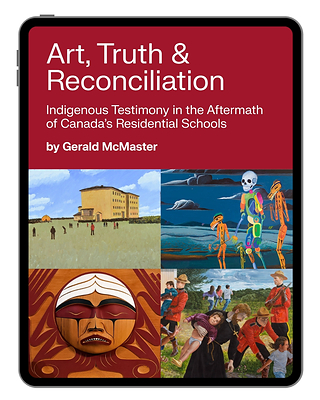
TORONTO, Sept. 29, 2026 /CNW/ — The Art Canada Institute (ACI) today launches Art, Truth & Reconciliation, a new free, bilingual online publication by renowned curator, scholar, and artist Gerald McMaster exploring the role of Indigenous art in preserving memory, bearing witness, and carrying forward the histories and ongoing legacies of Canada’s residential school system. Released for the National Day for Truth and Reconciliation, the book honours Survivors, the children who never returned home, and their families and communities.
In Art, Truth & Reconciliation, McMaster develops a new framework for understanding the role art has played in responding to the history of residential schools and the Truth and Reconciliation Commission’s Calls to Action. Through a rich selection of works and an accessible approach, the book brings authoritative scholarship on contemporary Indigenous art to readers across Canada and around the world.
Drawing upon decades of curatorial experience and close collaboration with artists and communities, McMaster structures the book as an intergenerational dialogue. Its three sections move from drawings created by children while attending residential schools, to works by Survivors reflecting on their experiences, to a new generation of Indigenous artists responding to the histories and ongoing legacies of the residential school system. Through selected significant works, McMaster traces connections across these generations while examining art as a form of testimony, remembrance, resilience, cultural continuity, and healing.
“Art has become one of the most powerful ways of carrying memory forward,” says McMaster. “The artists represented in this publication do more than recount history; they challenge us to listen and to recognize the resilience, creativity, and enduring knowledge of Indigenous Peoples. Their work reminds us that reconciliation is not a destination, but an ongoing responsibility.”
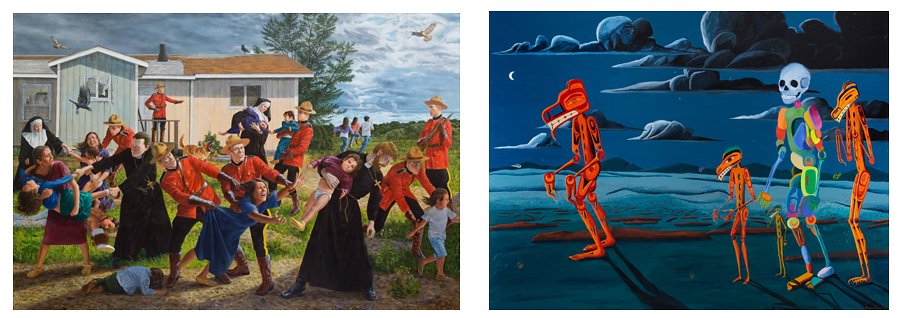
Featuring 70 key works by Survivors and leading Indigenous artists – including Rebecca Belmore’s Apparition, 2013; Kent Monkman’s The Scream, 2017; Lawrence Paul Yuxweluptun Lets’lo:steltun’s Indian Residential School, Leaving the Shallow Graves and Going Home, 2022; and Adrian Stimson’s Sick and Tired, 2006 – the book brings together a remarkable range of artistic practices and perspectives. The works address experiences of loss, survival, resistance, remembrance, and healing, while demonstrating the vital role that art has played in bringing the history of Canada’s residential schools to wider public attention.
“Gerald McMaster has transformed the study of Indigenous art in Canada through decades of scholarship and curatorial leadership,” says Sara Angel, Founder and Executive Director of the Art Canada Institute. “Art, Truth & Reconciliation supports ACI’s mission to make work about Canada’s art and artists freely available while creating opportunities for meaningful public engagement with the histories and ideas that continue to shape Canada. We are honoured to publish this important work.”
To date, ACI has published more than 70 expert-authored digital books that are available at no cost. As well, the Art Canada Institute develops Canada’s only comprehensive art education guides for teachers and students from kindergarten to grade 12 – content that is also free and available online, serving more than 700,000 educators.
To explore the Art Canada Institute’s open-access digital book Art, Truth & Reconciliation by Gerald McMaster, please visit: https://artcanada.com/books/online-books/art-truth-and-reconciliation/.
For press images and a full list of image credits, please visit: https://artcanadainstitute.sharepoint.com/:f:/g/IgDZgLzlN8cvTaJYT4UWfdszAZkdC45y-IqjzspmG6v5go4?e=Pl6g0g.
For media requests or for interviews with Gerald McMaster, author of Art, Truth & Reconciliation, or Sara Angel, Founder and Executive Director, Art Canada Institute, please contact:
- Lindsay Hill, NATIONAL Public Relations: [email protected]
- Alison Charron, NATIONAL Public Relations: [email protected]
About the Author
Gerald McMaster is a curator, artist, author, and professor and former director of Wapatah Centre for Indigenous Visual Knowledge at OCAD University, Toronto. With over forty years of international work and expertise in contemporary art, critical theory, museology, and Indigenous aesthetics, he has worked at the Art Gallery of Ontario, Toronto; the Smithsonian National Museum of the American Indian, Washington, D.C.; and the Canadian Museum of Civilization (now the Canadian Museum of History, Gatineau). As a curator, McMaster represented Canada at La Biennale di Venezia (1995) and the 16th Mostra di Architettura di Venezia (2018). In 2012, he was Artistic Director of the 18th Biennale of Sydney, Australia. He is also the author of many books, including Iljuwas Bill Reid: Life & Work (2020), Arctic/Amazon: Networks of Global Indigeneity (2023), and Reservation X: The Power of Place in Aboriginal Contemporary Art (1998). He is a néhiyaw (Plains Cree) and a citizen of the Siksika Nation.
About Art Canada Institute
The Art Canada Institute is the only national institution whose mandate is to promote the study of an inclusive, multi-vocal Canadian art history to as broad an audience as possible, on a digital platform, and free of charge in both English and French, across Canada and internationally. To accomplish this, ACI works with Canada’s leading cultural institutions, art historians, curators, and visual culture experts, and is dedicated to the creation of authoritative original content on the people, themes, and topics that have defined Canadian art history.
To learn more about ACI and to access our free digital library, please visit us:
artcanada.com
SOURCE Art Canada Institute
