
AIRO Group Holdings is a buy, this analyst says

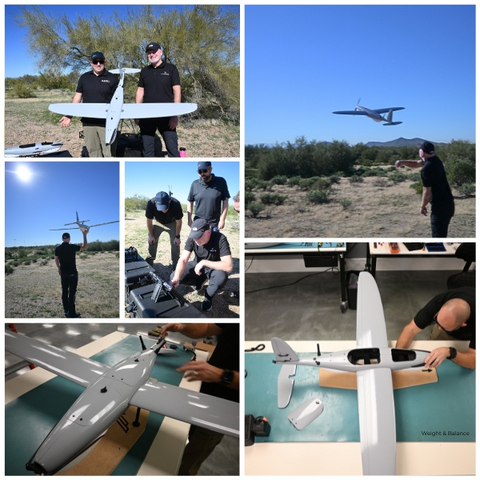
Roth Capital Partners analyst Craig Irwin initiated coverage of AIRO Group Holdings (Airo Group Holdings Stock Quote, Chart, News, Analysts, Financials NASDAQ:AIRO) with a “Buy” rating and US$16 .00 target, citing growing military drone demand, an established customer base and opportunities to expand sales to the U.S. defence sector.
In a Nov. 3 report, Irwin said the Virginia-based company has generated more than US$290-million in cumulative revenue since 2022, primarily through deliveries of its RQ-35 surveillance drones to Ukraine, but trades at a substantial discount to other drone manufacturers.
AIRO develops drones, avionics and military aviation training systems, with its drone business accounting for approximately 87% of revenue in 2025. Its principal product, the RQ-35 Heidrun, is a hand-launched drone used for intelligence, surveillance and reconnaissance (ISR) missions. The aircraft can operate for up to three hours, with a mission range of approximately 50 kilometres, including in environments where satellite navigation is disrupted.
Irwin believes AIRO’s experience supplying European defence customers, including NATO countries purchasing drones for Ukraine, provides a foundation for further growth.
The company manufactures drones in Denmark and recently established production in Arizona to pursue U.S. military contracts. Irwin said the RQ-35’s Blue UAS certification in July 2026 is particularly important because it establishes eligibility for U.S. government procurement.
“Visibility from DoW purchases after the mid-July Blue UAS certification could be a major catalyst, in our view,” he said.
U.S. military orders have not yet contributed materially to revenue, leaving potential upside beyond AIRO’s existing international business. The company’s drone backlog stood at approximately US$163-million at the end of the second quarter, largely comprising orders from European defence customers.
Irwin expects further growth from the RQ-70 Dainn, a larger surveillance drone scheduled to enter full production in January 2027. The aircraft has a range of approximately 100 kilometres and can remain airborne for eight to nine hours, allowing it to perform longer surveillance missions than the RQ-35.
“The RQ-70 should be compelling as a cost-effective long-range ISR alternative to the MQ9 when production starts in 1Q27,” Irwin said. He expects customers to evaluate the RQ-70 against established military surveillance systems, including the MQ-9 and ScanEagle.
AIRO is also developing two larger aircraft through its Jaunt division: the JC250 for cargo transport and military resupply, and the JX250 for longer-range surveillance missions. Both are designed to carry payloads exceeding 300 pounds, with production targeted for late 2027.
Irwin said customer commitments for these aircraft could provide additional growth opportunities as military customers expand their use of unmanned systems for logistics and reconnaissance.
AIRO’s Canadian operations could also benefit from increased defence spending. Its Jaunt division is developing aircraft in Mirabel, Quebec, and qualified for Canada’s Defence Drone Initiative Marketplace in October, allowing it to compete for Canadian military contracts.
Irwin said rising global defence budgets support the company’s longer-term outlook. Research firm IDTechX forecasts the global drone market will grow from approximately US$51-billion in 2025 to US$149-billion by 2036, representing annual growth of about 10%. However, he cautioned that government procurement schedules can produce volatile quarterly results, while expanding production capacity carries execution risks.
Irwin’s $16.00 target is based on three times estimated 2027 revenue, compared with an average multiple of 8.9 times for drone industry peers.
“We view a 3x multiple for AIRO as fair for the substantial deployment history as well as the healthy backlog and robust pipeline,” he said.
He expects AIRO to generate revenue of US$105-million and negative Adjusted EBITDA of US$19.2-million in fiscal 2026. For fiscal 2027, Irwin forecasts revenue of US$175-million and positive Adjusted EBITDA of US$11.6-million as production of the RQ-70 increases and the company pursues additional U.S. military orders. He expects further growth in fiscal 2028, with revenue reaching US$250-million and Adjusted EBITDA improving to US$56.8-million.
-30-
Rod Weatherbie
Writer
Rod Weatherbie is a journalist based in Prince Edward Island. Since 2004, he has written extensively about the Canadian property and casualty insurance landscape. He was also a founder and contributing editor for a Toronto-based arts website and a PEI-based food magazine. His fiction and poetry have been featured in The Fiddlehead, The Antigonish Review, and Juniper.