
Tersis Technologies and The Salem Group Sign MOU to Evaluate a Venezuela Joint Venture for Waste-to-Value Distributed Power
Compliance-first framework pairs SynGenic V3™ technology with Salem’s power development and operating experience, beginning with U.S. sanctions and export-control clearance
Miami, Florida–(Newsfile Corp. – October 12, 2026) – Tersis Technologies, Inc. (OTCID: TERS), a clean technology company advancing waste-to-value and circular infrastructure solutions, today announced that it has signed a Memorandum of Understanding with The Salem Group USA, LLC (“Salem”), a Miami-based power generation developer and operator, to evaluate forming a joint venture to develop, finance, deploy, and operate SynGenic V3™ waste-to-value and distributed power projects in the Bolivarian Republic of Venezuela.
The MOU, effective October 8, 2026, is a precursor to a possible joint venture. It sets out a phased work program for reaching definitive agreements and includes binding provisions covering sanctions and export-control compliance, anti-corruption, confidentiality, non-circumvention, and the protection of each party’s intellectual property. The MOU does not form a joint venture or other legal entity, and it does not obligate either party to contribute capital, technology, equipment, sites, or services.
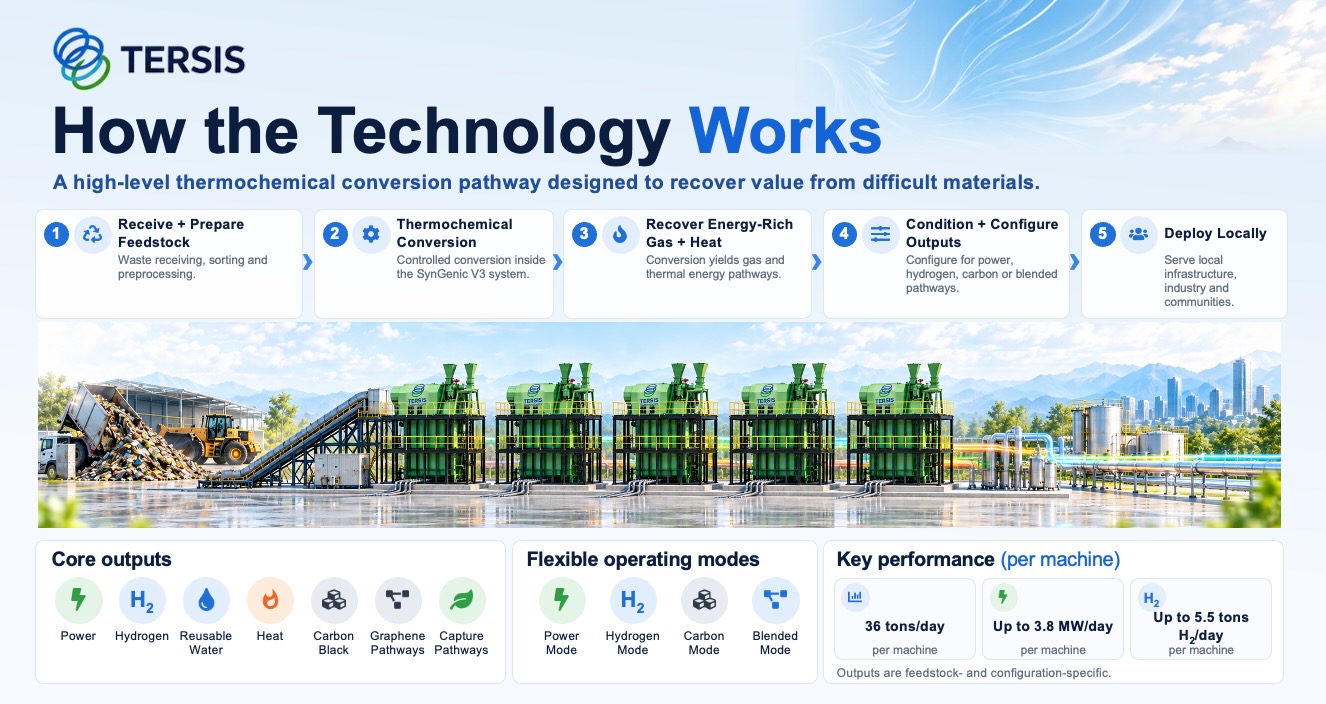
To view an enhanced version of this graphic, please visit:
https://images.newsfilecorp.com/files/12096/318495_image101026.jpg
Venezuela faces significant electricity supply shortfalls alongside ongoing solid-waste management needs. The parties believe that modular generation sited near waste sources and load centers may help address both. Under the framework, the parties intend to evaluate:
- Distributed power projects using SynGenic V3 technology at or near municipal solid waste, tire, industrial, agricultural, and other suitable waste streams;
- Hybrid configurations that combine SynGenic V3 units with Salem’s thermal, solar, and energy storage capabilities, where technically and commercially appropriate; and
- The sale of recovered co-products where markets exist.
Subject to definitive agreements, Tersis is expected to contribute the SynGenic V3 technology, engineering and process design, unit supply coordination, operator training, and technical support. Salem is expected to contribute project origination and development, regional market and offtaker relationships, engineering and construction management, grid interconnection, operations and maintenance, power purchase agreement structuring, and financing arrangements. Tersis retains all rights in the SynGenic V3 technology, and any license would be granted only under a separate definitive agreement.
Compliance comes first. Before either party engages with any counterparty in Venezuela on behalf of the proposed joint venture, the parties must complete a compliance clearance phase that includes written advice from qualified counsel on applicable U.S. sanctions and export-control laws, counterparty and payment-channel screening, any required licenses from the U.S. Department of the Treasury’s Office of Foreign Assets Control, and an anti-corruption protocol. Subsequent phases include market and authority mapping, site and feedstock screening, and definition of a first project. The parties have agreed to use good-faith efforts to negotiate a non-binding joint venture term sheet within 60 days after the compliance phase is completed.
“Venezuela has two problems that are usually treated separately: not enough reliable power, and too much waste with nowhere responsible to go,” said Antonio Uccello, Founder and Chief Executive Officer of Tersis Technologies. “Salem builds and runs power plants in difficult grids, and that operating discipline is exactly what a modular, waste-fed system needs to become a real project. We are going to do this in the right order: compliance clearance first, then sites and feedstock data, then a first project we can defend on engineering and economics.”
“Distributed generation works best when it sits close to the load and uses fuel that is already there,” said Pablo N. Barrios, Manager of The Salem Group USA, LLC. “Pairing SynGenic V3 with our development, construction, and operations experience gives us a way to evaluate projects that add capacity while addressing a waste problem communities live with every day. Our next step is the compliance and diligence work that has to come before anything else.”
About Tersis Technologies
Tersis Technologies, Inc. (OTCID: TERS) is a clean technology company focused on transforming waste streams into valuable resources through advanced thermochemical conversion, carbon utilization, renewable energy, materials recovery, and sustainable infrastructure solutions. Working with municipalities, industrial partners, and governments, Tersis advances scalable technologies, including SynGenic V3™ and PolyCycle™, designed to convert suitable waste streams into energy, recovered materials, carbon products, hydrogen, and other valuable outputs, depending on feedstock, system configuration, permitting, and final engineering.
For more information, visit Tersis.Tech (https://tersis.tech).
About The Salem Group
The Salem Group is a privately held power generation company that develops, builds, and operates generation assets in Latin America and the Caribbean, including thermal generation, utility-scale renewables, energy storage, distributed generation and microgrids, and operations and maintenance. The company works with utilities, governments, and industrial customers across the full asset lifecycle, from greenfield development and engineering through long-term power purchase agreements and operations.
For more information, visit salemgroup.us (https://salemgroup.us).
Forward-Looking Statements
This press release contains forward-looking statements within the meaning of the federal securities laws, including statements regarding the proposed joint venture, the work program, potential projects in Venezuela, anticipated contributions of the parties, the performance and applicability of SynGenic V3 technology, and the timing of any term sheet or definitive agreements. The Memorandum of Understanding is largely non-binding, and there can be no assurance that a joint venture will be formed, that definitive agreements will be executed, or that any project will be developed, financed, or built. Actual results may differ materially due to, among other factors, U.S. and other sanctions and export-control laws and the availability of any required licenses; political, regulatory, currency, payment, and security conditions in Venezuela; the outcome of due diligence, feedstock characterization, site selection, engineering, and permitting; the availability of financing and creditworthy offtake; and the negotiation of acceptable commercial terms. Forward-looking statements speak only as of the date they are made, and Tersis Technologies undertakes no obligation to update or revise them except as required by applicable law.
Media Contact
Tersis Technologies, Inc.
Scott St. John
+1 (303) 656-1782
[email protected]
SOURCE: Tersis Technologies, Inc.
###
To view the source version of this press release, please visit https://www.newsfilecorp.com/release/318495