
Is Universal Display Corporation undervalued?

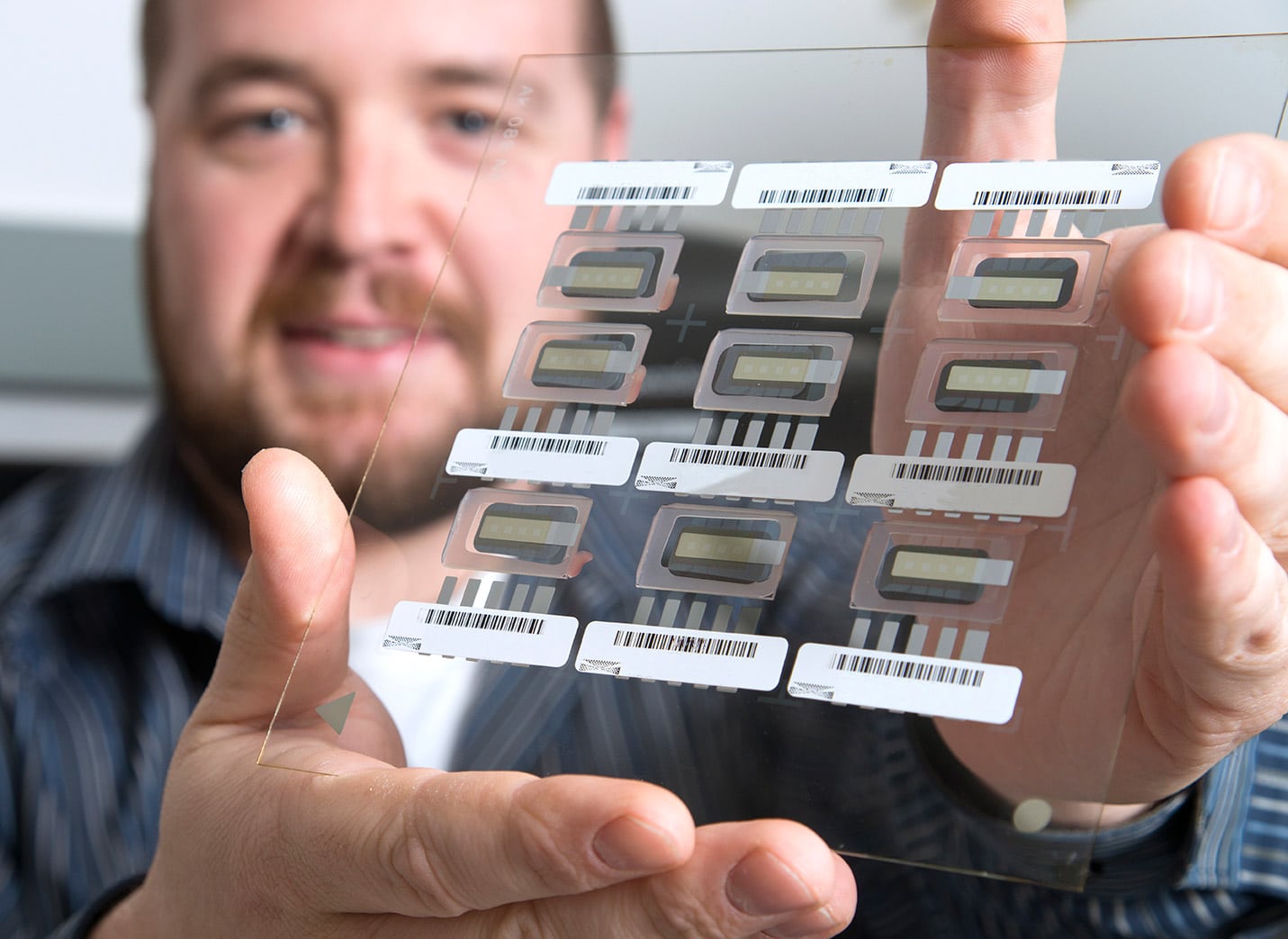
Roth Capital Partners analyst Scott Searle maintained his “Buy” rating and US$158.00 target on Universal Display Corporation (Universal Display Corporation Stock Quote, Chart, News, Analysts, Financials NASDAQ:OLED), saying new manufacturing capacity and potential commercialization of its blue OLED technology could return the company to growth in 2027.
Searle lowered his revenue estimates on Oct. 29 following slightly weaker-than-expected third-quarter results, but said the shares appear attractively valued after a prolonged period of sluggish sales. “We expect single-mid-digit 2027 growth,” Searle said.
Universal Display, which supplies materials and licenses technology for organic light-emitting diode (OLED) screens, reported Q3 revenue of US$160.4-million, up 15% year-over-year but below consensus of US$162.7-million. Materials revenue was US$79.7-million, up 20% sequentially but down 3% year-over-year, reflecting continued weakness in consumer electronics, particularly lower-priced smartphones and televisions. Adjusted earnings per share of approximately US$1.23 were also slightly below Searle’s expectations.
Universal Display maintained its 2026 revenue guidance of US$630-million to US$670-million, with management expecting results near the lower end of that range.
Searle said the outlook implies fourth-quarter revenue exceeding US$170-million, supported by seasonal demand, new products and additional manufacturing capacity. “This continues to reflect a combination of new capacity (Samsung and BoE 8.6 gen capacity), new products (new products such as Apple iPhone Duo), and traditional 2H seasonality,” he said.
The analyst expects a larger contribution from new OLED manufacturing facilities beginning in 2027, particularly as the technology expands beyond smartphones into laptops, tablets and monitors.
Four new 8.6-generation manufacturing plants are expected to enter commercial production between 2026 and 2028, increasing the industry’s ability to produce larger OLED displays more economically. Searle estimates that OLED penetration in information technology devices was approximately 5% in 2025, leaving considerable room for growth. He expects IT applications to account for more than 30% of total OLED display area by the end of the decade, up from approximately 10% to 15% in 2025.
Another potential catalyst is Universal Display’s long-awaited blue phosphorescent emitter technology, which could improve display efficiency and create an additional revenue stream.
“While Blue emitters retain a complicated investor history of recent disappointments, engagement across the customer landscape remains active,” Searle said. “We believe that timeline has been prolonged as customers have explored various hybrid architectures using both phosphorescent and fluorescent emitters.”
Searle expects initial commercialization in 2027, followed by broader adoption in 2028, although the timing remains uncertain.
He estimates blue emitters could contribute more than US$250-million in additional annual revenue and over US$2.50 in incremental earnings per share by 2030.
Searle reduced his fiscal 2026 revenue estimate to US$627.2-million from US$631-million and his 2027 estimate to US$672.1-million from US$689.4-million. His revised 2027 non-GAAP earnings forecast is US$5.50 per share.
Despite the estimate reductions, Searle said Universal Display’s valuation remains attractive at approximately 13 times estimated 2027 earnings, excluding roughly US$20 per share in net cash. The company ended Q3 with US$903-million in cash and long-term investments and no debt, providing flexibility for additional share repurchases.
“While off its recent bottom, this continues to be a level not seen by OLED in at least a half decade,” Searle said.
Searle expects Universal Display to generate revenue of US$627.2-million in fiscal 2026, improving to US$672.1-million in fiscal 2027, as new manufacturing capacity and product adoption begin supporting growth.
-30-
Rod Weatherbie
Writer
Rod Weatherbie is a journalist based in Prince Edward Island. Since 2004, he has written extensively about the Canadian property and casualty insurance landscape. He was also a founder and contributing editor for a Toronto-based arts website and a PEI-based food magazine. His fiction and poetry have been featured in The Fiddlehead, The Antigonish Review, and Juniper.
Related Posts
In an April 1 report, Roth Capital Markets analyst Scott Searle maintained his “Buy” rating and $180.00 target on Universal...
After a third quarter that missed expectations, Roth MKM analyst Scott W. Searle is still bullish on Universal Display Corporation...