
MSA Drilling Confirms Linked High-grade Polymetallic Breccias – Porphyry Cu-Mo-Au-Ag Centre: Drills 186 m of 0.48% Copper, 0.18 g/t Gold and 10.1 g/t Silver to End of Hole
TSX-V: MSR
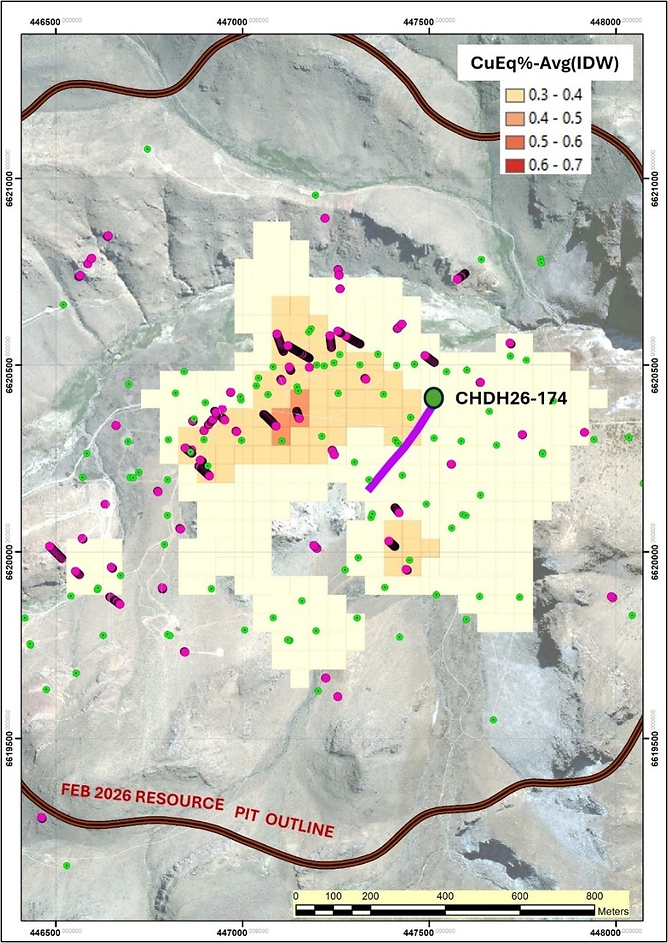
TORONTO, Nov. 10, 2026 /CNW/ — Minsud Resources Corp. (TSXV: MSR) (“Minsud” or the “Company”), is pleased to report assay results from CHDH26-174, the first hole of the 10,500 m diamond drilling program under way at the Chita Valley Cu-Au-Ag-Mo-Zn-Pb project in San Juan Province, Argentina. This drilling program follows the National Instrument 43-101 – Standards of Disclosure for Mineral Projects (“NI 43-101“) compliant resource delineation conducted over Chita’s two open-pittable deposits: i) Chinchillones polymetallic sulphide deposit with Indicated Resources of 1,014 kt CuEq @ 0.44 CuEq %, and Inferred Resources of 2,823 kt CuEq @ 0.36 CuEq % and ii) Chita South Porphyry (PSU) oxide deposit with Indicated Resources of 19 kt Cu @ 0.30% Cu and Inferred Resources of 510 kt Cu @ 0.29% Cu. The Mineral Resource Estimates referenced in this news release are based on the Mineral Resource Estimate announced by the Company on February 27, 2026, and supported by the independent NI 43-101 technical report titled “NI 43-101 Technical Report Mineral Resource Estimate on Chita Valley Project, Iglesia Department, San Juan, Argentina”, dated April 13, 2026, which is available under the Company’s issuer profile on SEDAR+ at www.sedarplus.ca. Mineral Resources are reported above net smelter return cut-offs within an optimised pit shell; Mineral Resources that are not Mineral Reserves do not have demonstrated economic viability. Readers are referred to the Technical Report for the full Mineral Resource statement, including cut-off grades, metal prices, metallurgical recoveries and copper-equivalent formulas.
HIGHLIGHTS:
- 186.0 m of 0.48% Cu, 0.18 g/t Au and 10.1 g/t Ag (with 86 ppm Mo) from 560 m to the end of the hole at 746 m, including:
- 35.0 m of 0.81% Cu, 0.28 g/t Au and 26.4 g/t Ag from 564 m, within which
-10.0 m of 1.42% Cu, 0.27 g/t Au and 26.8 g/t Ag from 564 m; and
-5.0 m of 1.13% Cu, 0.48 g/t Au and 68.0 g/t Ag from 588 m in magmatic-hydrothermal breccia - 86.0 m of 0.43% Cu, 0.18 g/t Au and 7.2 g/t Ag from 610 m, and
- 42.0 m of 0.49% Cu, 0.13 g/t Au and 184 ppm Mo from 704 m to the end of the hole, including 26.0 m of 0.60% Cu and 206 ppm Mo, with molybdenum reaching 403 ppm in the final metres
- 35.0 m of 0.81% Cu, 0.28 g/t Au and 26.4 g/t Ag from 564 m, within which
- 58.0 m of 1.00% Zn, 0.23% Pb and 9.4 g/t Ag from 492 m, a separate zinc-lead-silver zone, including 10.0 m of 1.67% Zn, 0.39% Pb, 15.2 g/t Ag and 0.23 g/t Au from 520 m.
- 268.0 m of 0.20% Cu, 0.09 g/t Au and 5.1 g/t Ag from 140 m in the upper high-sulphidation zone, including 38.0 m of 0.29% Cu and 7.0 g/t Ag from 300 m and 20.0 m of 0.34% Cu and 9.0 g/t Ag from 360 m
- Mineralisation is open at depth. Copper grade is sustained to the bottom of the hole and molybdenum rises 50-fold over the final 100 m, which is interpreted to be indicative of a porphyry copper-molybdenum system beneath the epithermal zone
A single hole, three mineralised systems stacked on top of each other
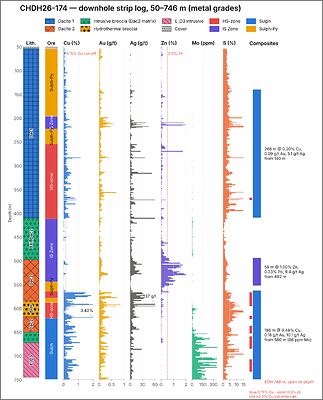
CHDH26-174 cut 696 m of continuous sulphide mineralisation from the base of cover at 50 m to the end of the hole at 746 m. The hole passes downward through (1) a pyrite-rich phyllic halo and high-sulphidation (HS) copper-gold-silver zone hosted in dacite porphyry (Dac1), (2) an intermediate-sulphidation (IS) zinc-lead-silver zone in intrusive breccia and dacite porphyry (Dac2) and (3) a deep high-grade HS copper-gold breccia zone that grades downward into molybdenum-rich sulphide mineralisation in a separate dioritic intrusion phase (E_D3). The grade increases with depth.
COMMENT
Dr. Renato Bobis, VP-Exploration at Minsud Resources, commented: “CHDH26-174 confirms continuation of the high-grade breccias and porphyry mineralisation. The geochemistry is telling us the system is still getting hotter as we go down: molybdenum climbs to over 300 ppm in the last few metres and the hole stopped in 42m @ 0.49% Cu and 0,13 gpt Au and 184 ppm Mo (including 26m @ 0.60% Cu, 206 ppm Mo from 704m). The stacked high-sulphidation, intermediate-sulphidation and porphyry-style signatures in the drill hole are interpreted as reflecting a high-sulphidation epithermal-to-porphyry transition.”
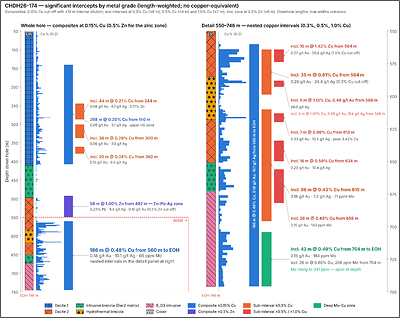
Table 1. Significant intercepts, CHDH26-174
|
Interval |
From (m) |
To (m) |
Length (m) |
Cu (%) |
Au (g/t) |
Ag (g/t) |
Zn (%) |
Pb (%) |
Mo (ppm) |
|
Whole hole |
50 |
746 (EOH) |
696 |
0.22 |
0.10 |
6.1 |
0.15 |
0.04 |
24 |
|
Upper HS zone |
140 |
408 |
268 |
0.20 |
0.09 |
5.1 |
0.09 |
0.03 |
1 |
|
incl. |
244 |
288 |
44 |
0.21 |
0.08 |
6.1 |
0.17 |
0.07 |
1 |
|
incl. |
300 |
338 |
38 |
0.29 |
0.06 |
7.0 |
0.06 |
0.01 |
1 |
|
incl. |
360 |
380 |
20 |
0.34 |
0.09 |
9.0 |
0.04 |
0.02 |
2 |
|
Zn-Pb-Ag zone (0.5% Zn cut-off) |
492 |
550 |
58 |
0.04 |
0.09 |
9.4 |
1.00 |
0.23 |
2 |
|
incl. |
502 |
514 |
12 |
0.08 |
0.10 |
14.9 |
1.27 |
0.41 |
1 |
|
incl. |
520 |
530 |
10 |
0.05 |
0.23 |
15.2 |
1.67 |
0.39 |
2 |
|
Breccia + porphyry zone |
560 |
746 (EOH) |
186 |
0.48 |
0.18 |
10.1 |
0.04 |
0.01 |
86 |
|
incl. |
564 |
599 |
35 |
0.81 |
0.28 |
26.4 |
0.08 |
0.01 |
6 |
|
incl. |
564 |
574 |
10 |
1.42 |
0.27 |
26.8 |
0.03 |
0.01 |
1 |
|
incl. |
588 |
593 |
5 |
1.13 |
0.48 |
68.0 |
0.14 |
0.02 |
5 |
|
incl. |
588 |
590 |
2 |
1.97 |
0.58 |
124.0 |
0.15 |
0.02 |
3 |
|
incl. |
610 |
696 |
86 |
0.43 |
0.18 |
7.2 |
0.03 |
0.01 |
71 |
|
incl. |
613 |
620 |
7 |
0.96 |
0.33 |
13.5 |
0.05 |
0.02 |
13 |
|
incl. |
634 |
650 |
16 |
0.59 |
0.20 |
10.4 |
0.02 |
0.01 |
18 |
|
incl. |
656 |
682 |
26 |
0.49 |
0.15 |
5.5 |
0.05 |
0.01 |
143 |
|
incl. |
704 |
746 (EOH) |
42 |
0.49 |
0.13 |
4.5 |
0.01 |
0.00 |
184 |
|
incl. |
704 |
730 |
26 |
0.60 |
0.13 |
5.0 |
0.01 |
0.00 |
206 |
|
Downhole lengths; true widths are not yet known. Composites use a 0.15% Cu cut-off with up to 12 m of internal dilution (0.5% Zn with up to 6 m for the zinc zone); “incl.” intervals use 0.3% Cu (≤6 m dilution), 0.5% Cu (≤4 m), 1.0% Cu (≤2 m) and 1.0% Zn (≤4 m) cut-offs. Grades are length-weighted averages of the original samples with no top-cut. No metal-equivalent values are used in this release. |
Geology of CHDH26-174: three mineralised systems in one hole
The hole cut 696 m of continuous sulphide mineralisation from the base of cover at 50 m to the end of the hole at 746 m, passing downward through (1) a pyrite-rich phyllic halo and high-sulphidation (HS) copper-gold-silver zone hosted in dacite porphyry, (2) an intermediate-sulphidation (IS) zinc-lead-silver zone in intrusion breccia and a second dacite porphyry, and (3) the high-grade magmatic-hydrothermal breccia zone that grades downward into molybdenum-bearing porphyry mineralisation in a diorite porphyry.
50–410 m. Dacite porphyry (Dac1). Pyrite-dominant phyllic alteration (sericite-quartz-pyrite, 2–4% S) grading at 254 m into phyllic alteration with an advanced-argillic overprint and HS-style copper-gold-silver mineralisation. Sodium is almost completely stripped (Na/Al below 0.04 molar) throughout this interval.
410–560 m. Intrusion breccia and dacite porphyry (Dac2). Intermediate-argillic alteration (illite-dominant) with an IS-style zinc-lead-silver zone: sphalerite-galena veining with a tightly correlated Zn-Cd-Pb-Tl-Mn suite, peripheral to the copper core.
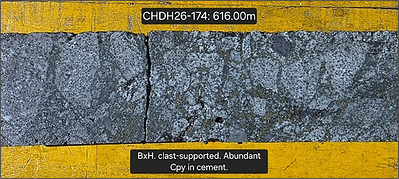
560–673 m. Dacite porphyry (Dac2) and magmatic-hydrothermal breccia (BxH). The high-grade heart of the hole. Advanced-argillic alteration with 1.42% Cu over 10 m from 564 m, and a 33 m magmatic-hydrothermal breccia (585–618 m) with copper-sulphide cement carrying: 5 m of 1.13% Cu, 0.48 g/t Au and 68 g/t Ag from 588 m. Copper is accompanied by Bi, In, Te, Sn and W, the enargite-tennantite-tetrahedrite suite typical of high-sulphidation copper-gold systems.
673–746 m. Diorite porphyry (E_D3). A geochemically distinct intrusion (Al/Ti ~80, Nb/Y ~0.6, very low Zn and Pb) carrying disseminated chalcopyrite-pyrite at 0.4–0.6% Cu with molybdenum rising steadily to 200–340 ppm. Molybdenum averages about 190 ppm over the final 40 m against 1–6 ppm in the upper 500 m, a 50-fold increase that marks the transition from the epithermal advanced-argillic zone into the underlying porphyry environment.
Quality Assurance/Quality Control
All core samples are cut and prepared on-site at the project area. The sample lengths are usually 2 m, except in areas with low recovery (loss areas, faults, etc.) and breaks from discrete principal geological features (e.g., vein, vein breccia). Drill core sizes of the drillholes are largely HQ-diameter.
Cutting is carried out by trained Minera Sud Argentina (MSA) personnel. Cores are split using the industry-standard Corewise automatic circular diamond blade rotary saw in the middle of the core, around 1 cm away from the core orientation mark. Half-core and duplicate samples, including all fragments, are placed in labelled plastic bags. Each bag is marked with the sample number and sealed using plastic security straps.
All core samples are submitted to ALS Patagonia S.A. in Mendoza as the primary laboratory for sample preparation. This ISO 9001-accredited facility carries out the sample preparation, and the prepared pulp samples are then sent to ALS Perú S.A. in Lima, Peru. The ALS Perú S.A. laboratory is accredited under ISO 9001:2008 and ISO 17025, ensuring compliance with international standards.
The analytical protocols are outlined as follows:
- ME-MS61 and ME-MS61m: Multi-trace analyses of 48 elements with a 4-acid digestion. A prepared sample (0.25 g) is digested with perchloric, nitric, and hydrofluoric acids to dryness. The residue is taken up in a volume of 12.5 mL of 10 % hydrochloric acid. The resulting solution is analyzed by ICP-AES for major elements. Results are corrected for spectral interelement interference.
- ME-OG62: For samples over-limit, analysis is by four-acid digestion using conventional ICP-AES analysis for Ag, As, Cu, Mo, S, Pb, and Zn.
- Fire Assay Procedure Au-AA24 (50g): Gold is analyzed using a conventional fire assay fusion method with Atomic Absorption Spectroscopy (AAS).
MSA follows industry standard procedures for the work with a quality assurance/quality control (QA/QC) program. Field duplicates, standards and blanks are included with all sample shipments to the principal laboratory. MSA detected no significant QA/QC issues during review of the data.
Qualified Persons and Technical Information
The scientific and technical information in this press release has been compiled, reviewed and approved by Dr Renato Bobis, MAusIMM CP (Geo), part-time VP-Exploration of the Company, and is a qualified person as defined under NI 43-101. Dr Bobis has sufficient experience relevant to the style of mineralisation and type of deposit under consideration and to the activity which he is undertaking to qualify as a Qualified Person.
About the Chita Valley Project, San Juan Province
The Chita Valley Project is a large resource-delineation to exploration-stage porphyry system with widespread porphyry style Cu-Mo-Au and polymetallic Ag-Pb-Zn mineralization. The project hosts two (2) open-pittable NI 43-101 compliant resource bases, comprising the Chinchillones polymetallic sulphide deposit and the Chita South Porphyry supergene copper deposit.
San Juan Province of Argentina has a robust mining sector and recognizes the important economic benefits of responsible development of its substantial mineral resource endowment. The Chita Valley Project is owned and managed by MSA, of which Minsud indirectly holds a 49.9% interest. The other 50.1% interest in MSA is indirectly owned by South32. Minsud and South32 entered into a shareholders’ agreement to govern the management and operation of MSA which will include further exploration.
About Minsud Resources Corp.
Minsud is a mineral exploration company focused on exploring its flagship Chita Valley Cu-Mo-Au-Ag-Pb-Zn Project, in the Province of San Juan, Argentina. The Company’s shares are listed on the TSX-V under the trading symbol “MSR”, and on the OTCQX under the symbol “MDSQF”.
About South32 Limited
South32 Limited is a globally diversified mining and minerals company. The company’s purpose is to make a difference by developing natural resources, improving people’s lives now and for generations to come. South32 Limited is trusted by its owners and partners to realise the potential of their resources. South32 Limited produces minerals and metals critical to the world’s energy transition from operations across the Americas, Australia and Southern Africa, and the company is discovering and responsibly developing its next generation of mines. South32 Limited aspires to leave a positive legacy and build meaningful relationships with its partners and communities to create brighter futures together.
CAUTIONARY STATEMENT REGARDING FORWARD-LOOKING INFORMATION:
This news release includes certain information that may constitute forward-looking information under applicable Canadian securities laws. Forward-looking information includes, but is not limited to, statements about strategic plans, spending commitments, future operations, results of exploration, anticipated financial results, future work programs, capital expenditures and objectives. Forward-looking information is necessarily based upon a number of estimates and assumptions that, while considered reasonable, are subject to known and unknown risks, uncertainties, and other factors which may cause the actual results and future events to differ materially from those expressed or implied by such forward-looking information including, but not limited to: fluctuations in the currency markets (such as the Canadian dollar, Argentina peso, and the U.S. dollar); changes in national and local government, legislation, taxation, controls, regulations and political or economic developments in Canada and Argentina or other countries in which the Corporation may carry on business in the future; operating or technical difficulties in connection with exploration and development activities; risks and hazards associated with the business of mineral exploration and development (including environmental hazards or industrial accidents); risks relating to the credit worthiness or financial condition of suppliers and other parties with whom the Company does business; presence of laws and regulations that may impose restrictions on mining, including those currently enacted in Argentina; employee relations; relationships with and claims by local communities; availability and increasing costs associated with operational inputs and labour; the speculative nature of mineral exploration and development, including the risks of obtaining necessary licenses, permits and approvals from government authorities; business opportunities that may be presented to, or pursued by, the Company; challenges to, or difficulty in maintaining, the Company’s title to properties; risks relating to the Company’s ability to raise funds; and the factors identified under “Risk Factors” in the Company’s Filing Statement dated April 27, 2011. There can be no assurance that such information will prove to be accurate, as actual results and future events could differ materially from those anticipated in such information. Accordingly, readers should not place undue reliance on forward-looking information. All forward-looking-information contained in this news release is given as of the date hereof and is based upon the opinions and estimates of management and information available to management as at the date hereof. The Company disclaims any intention or obligation to update or revise any forward-looking information, whether as a result of new information, future events or otherwise, except as required by law.
Neither the TSX Venture Exchange nor its Regulation Services Provider (as that term is defined in the policies of the TSX Venture Exchange) accepts responsibility for the adequacy or accuracy of this release.
SOURCE Minsud Resources Corp.
