
Obadjiwan-Fort Témiscamingue National Historic Site Management Plan tabled in Parliament
Obadjiwan–Fort Témiscamingue National Historic Site is the first national historic site in Canada to be co-owned with an Indigenous nation
GATINEAU, QC, June 18, 2026 /CNW/ – To continue along this path of collaborative management, the new management plan will guide the site’s governance for the next ten years. It provides direction for the site, shares and presents Indigenous and non-Indigenous perspectives, and guides actions related to the protection of cultural and natural resources, visitor experience, and tourism positioning.
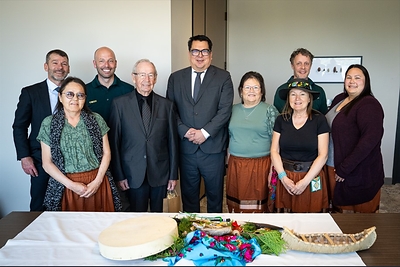
In 2019, the signing of a Trust Patrimony Agreement made Obadjiwan–Fort Témiscamingue National Historic Site the first national historic site in Canada to be co-owned by an Indigenous Nation, the Timiskaming First Nation (Anishinabe Algonquin). Under this unique agreement, the strategic management of the site is overseen by a fiduciary committee made up of Anishinabe Algonquin representatives from the Timiskaming First Nation, members of the non-Indigenous community of Témiscamingue, and Parks Canada.
Several other sites across Canada are co‑managed with First Nations, Métis and Inuit partners, reflecting a shared commitment to stewardship, respect and reconciliation.
The updated Obadjiwan–Fort Témiscamingue National Historic Site Management Plan sets out the following key strategies:
- To be a place of convergence and collaboration, whose vitality reflects the aspirations of the communities linked to it.
- To be a living, protected heritage site, showcasing the diversity of the cultures that have shaped it and the nature that surrounds it.
- To collaborate with partners from the Témiscamingue and Indigenous communities to better position the site as a regional attraction and broaden its reach.
This Management Plan was developed in close collaboration with the fiduciary committee, following consultations with Indigenous communities in the Abitibi-Témiscamingue region, stakeholders in the tourism industry, the local community, as well as with the general public.
Reviewed every ten years, management plans are a requirement of the Parks Canada Agency Act and guide the management of national parks, national heritage places and national marine conservation areas.
To find out more about the rich programming and services on offer for 2026, visit the Obadjiwan–Fort Témiscamingue National Historic Site website.
Quotes
“Collaboration with Indigenous communities across the country remains at the heart of Parks Canada’s priorities, as we work with key partners. This new management plan for Obadjiwan–Fort Témiscamingue National Historic Site translates this vision into action. It reflects the tangible results of consultation and a shared commitment to stewardship. As Minister of the Environment, Climate Change and Nature, I am pleased to support the collective work of all stakeholders, and to table in Parliament the management plan for Obadjiwan–Fort Témiscamingue National Historic Site of Canada. I would like to thank all those who participated in the development of the management plan that will help shape the future of this treasured place.”
The Honourable Julie Dabrusin
Minister of the Environment, Climate Change and Nature
“Obadjiwan-Fort Témiscamingue is a unique site. The site is co-owned by Parks Canada and Timiskaming First Nation. This involves a fiduciary committee. The fiduciary committee is made up of people who believe in the natural beauty of the site and its potential to be a star attraction in the region.”
Alison McBride
Co-President, Obadjiwan-Fort Témiscamingue Fiduciary Committee
“Now recognized as a National Historic Site of Canada, Obadjiwan–Fort-Témiscamingue is serving as a model for society as a whole. Demonstrating unprecedented openness, Parks Canada has allowed a fiduciary committee made up of representatives of the Timiskaming community and the Témiscamingue population to collaborate and work actively to present the site and recognize and express the cultures that have brought it to life.”
Claude Gagnon
Co-President, Obadjiwan-Fort Témiscamingue Fiduciary Committee
“Parks Canada will continue its efforts to strengthen co-management and shared decision-making, in keeping with the Indigenous Stewardship Policy, which lays the foundation for equitable, effective and collaborative stewardship with Indigenous communities, now and in the future. This management plan reflects Parks Canada’s commitment to strengthening its relationships with Indigenous peoples, local stakeholders and tourism partners, in order to present to the Canadian public and visitors the stories and places that contribute to our collective identity.”
Nadine Spence
Vice-President, Indigenous Stewardship and Cultural Heritage, Parks Canada
Quick facts
- The site was designated to be of national significance by the Historic Sites and Monuments Board of Canada in 1967 as “Fort Témiscamingue.” The objective was to commemorate the trading post’s role in the fur trade and the rivalry between the French and British to exploit the supply of pelts in Hudson’s Bay. The site was renamed the “Obadjiwan–Fort Témiscamingue” after a review of its designation in 2018 highlighted its important connection to the Anishinabe Algonquin Nation, which used the land for several millennia and played an important role in the fur trade. The designation also recognizes the site’s significance as an Indigenous gathering place in the 19th century, for Anishnabe Algonquin Nation, particularly for the Timiskaming First Nation.
- The site on the shores of Lake Timiskaming has been a meeting place and a place of Indigenous presence for over 6,000 years, providing an enchanting natural setting for memorable family experiences.
- In the Anishnabe language, Obadjiwan means “where the water rises in the rapids.”
- In 2019, the Trust Patrimony Agreement was signed, and a 50% undivided co-ownership in the historic site was transferred to the Obadjiwan Corporation. This agreement makes Obadjiwan–Fort Témiscamingue the first national historic site in Canada to be co-owned.
Related products
Obadjiwan–Fort Témiscamingue National Historic Site Management Plan
Associated links
Parks Canada
Parks Canada management plans
Parks Canada Indigenous stewardship policy
SOURCE Parks Canada (HQ)
