
Collective Mining Drills 146.10 m @ 1.07 g/t AuEq* at Apollo’s Shallow Halo Zone, Up to 60 Meters Beyond the Mineral Resource Boundary
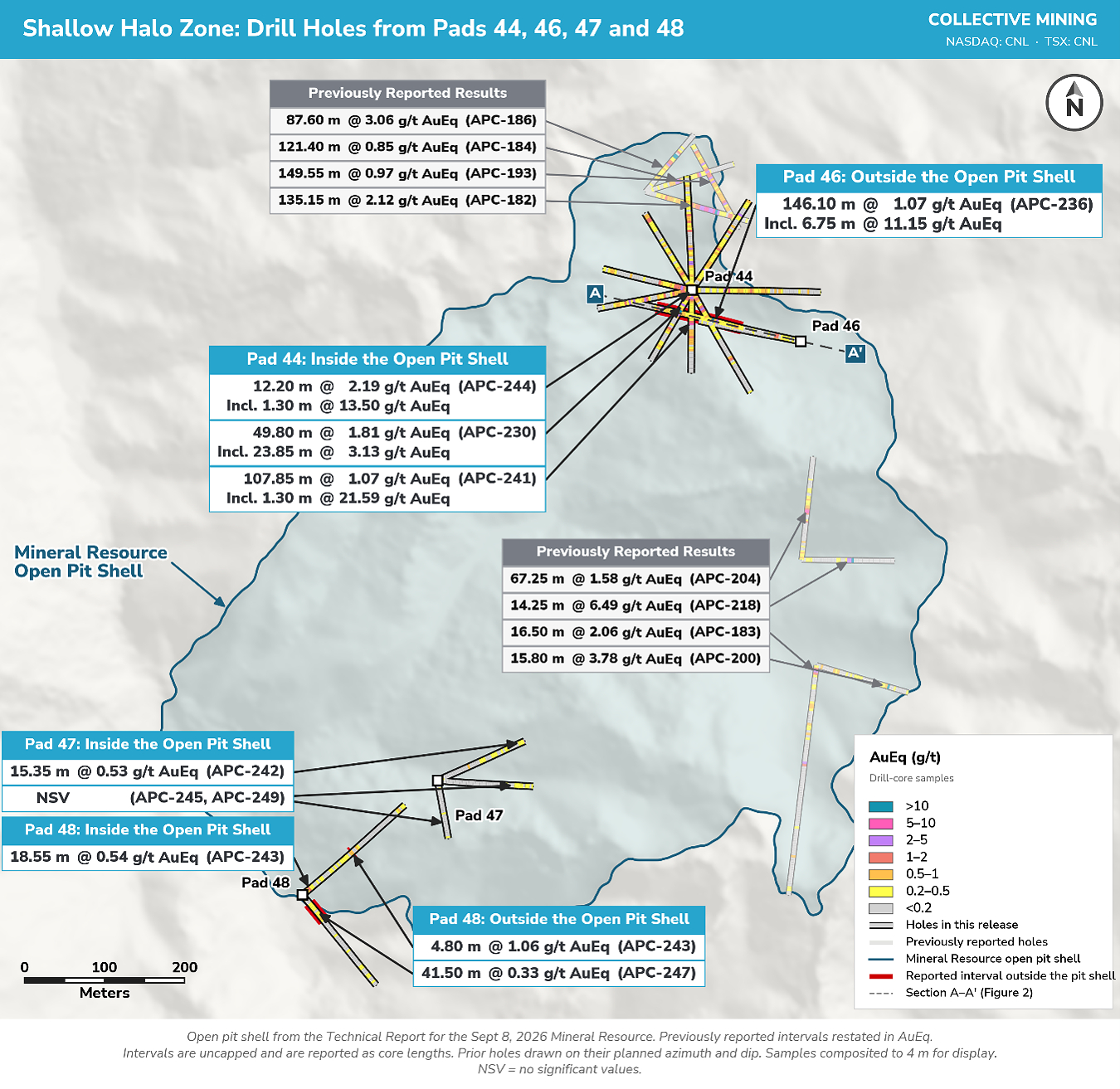
- Drilling from Pad 44 and Pad 46 in the northern portion of the Shallow Halo Zone (“SHZ”) intersected gold-silver mineralization outside the current Mineral Resource, including:
- 107.85 m at 1.07 g/t AuEq (0.79 g/t Au, 14 g/t Ag) from 3.75 m, including 16.00 m at 2.88 g/t AuEq (2.36 g/t Au, 27 g/t Ag) from 5.70 m in oxide rock, in APC-241
- 49.80 m at 1.81 g/t AuEq (1.33 g/t Au, 25 g/t Ag) from 5.10 m, including 23.85 m at 3.13 g/t AuEq (2.31 g/t Au, 41 g/t Ag, 0.04% Cu) from 29.15 m in transition rock, in APC-230
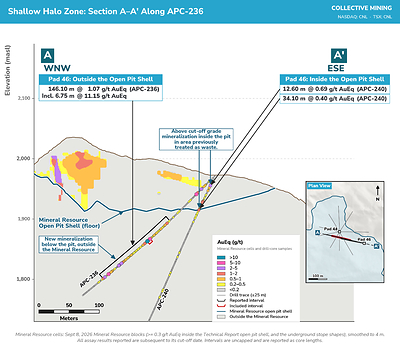
- 146.10 m at 1.07 g/t AuEq (0.66 g/t Au, 19 g/t Ag, 0.04% Cu) from 106.50 m, including 6.75 m at 11.15 g/t AuEq (9.27 g/t Au, 91 g/t Ag, 0.11% Cu) from 150.45 m, below the floor of the open pit shell and up to approximately 60 m beyond the Mineral Resource boundary, in APC-236
- All ten holes drilled from Pad 44 intersected gold-silver mineralization inside the open pit shell, most of it in areas previously treated as waste.
- Of the 17 SHZ holes in this release, 15 returned intervals above the 0.30 g/t AuEq open-pit cut-off grade. Since the Mineral Resource announcement on September 8, 2026, 59 of 64 new SHZ holes (92%) have returned intervals above this cut-off grade.
*APC-236: 1.07 g/t AuEq (0.66 g/t Au, 19 g/t Ag and 0.04% Cu).
MIAMI, Nov. 18, 2026 /CNW/ — Collective Mining Ltd. (NASDAQ: CNL) (TSX: CNL) (“Collective” or the “Company”) announces assay results for seventeen diamond drill holes at the Guayabales Project in Caldas, Colombia, targeting the Shallow Halo Zone (“SHZ”) of the Apollo deposit (“Apollo”) from four drill pads: Pad 44, Pad 46, Pad 47 and Pad 48. The SHZ is an interpreted 2.4-kilometer-long, 200-meter-wide, precious-metal-dominant target area located largely within the Mineral Resource open pit shell. The holes in this release were drilled largely into areas not included in the maiden Mineral Resource and previously treated as waste in the pit shell. Based on surface exploration sampling, mineralization at the northern edge of the SHZ potentially extends well beyond the current open pit shell.
The results show gold-silver mineralization starting from near surface in every hole drilled from Pad 44 and a broad interval of mineralization below the floor of the open pit shell at Pad 46. Of the 17 holes, 15 returned intervals above the 0.30 g/t AuEq open-pit cut-off grade, and most of the reported mineralization lies outside the current Mineral Resource. Approximately 77% of the mineralized meters within the open pit shell are in oxide and transition rock. The results follow the Company’s October 27, 2026, release of twenty-four SHZ holes and continue to test one of the key areas for potential future Mineral Resource growth at Apollo.
Ari Sussman, Executive Chairman, commented: “An open pit shell is an economic line drawn around the drilling of its day, not a geological boundary. The Shallow Halo Zone is showing the difference: we are finding gold and silver from surface in ground the shell carries as waste, and now beneath the floor of the shell itself. With much of the halo still to be drilled, we believe the open pit portion of Apollo has considerable room to grow.”
To date, Collective has received assays for 213,000 meters of diamond drilling across the Guayabales and San Antonio projects, including results for 152,000 meters at the flagship Apollo deposit, which anchors the Guayabales Project. Assay results for several drill holes across the property are expected in the coming weeks..
The Company is fully funded for its planned 2026 program, which envisions up to 90,000 meters of drilling. The Company presently has 13 diamond drill rigs operating across the Guayabales Project, two of which are dedicated to the SHZ. The first track-mounted rig for deep drilling is now operating on site, and a second is expected in December. An updated Mineral Resource incorporating approximately 100,000 meters of additional drilling is expected between Q4 2027 and Q1 2028, followed by a Preliminary Economic Assessment shortly thereafter.
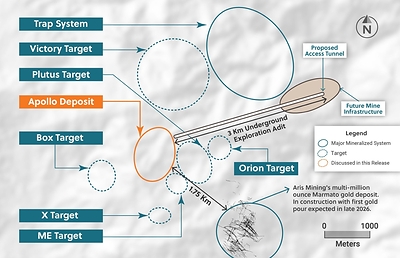
Construction of the planned approximately 3-kilometer underground exploration adit is expected to commence this month. The adit is designed to provide underground drilling platforms, beginning with the Trap system in Q1 2027, followed by the Plutus target and ultimately the Ramp Zone at Apollo, while allowing the Company to test any additional mineralization intersected along its route. The Company is targeting the second half of 2027 to submit the environmental license application for Apollo to Colombia’s National Environmental Licensing Authority (Autoridad Nacional de Licencias Ambientales, “ANLA”).
Drill Results and Geological Context (See Table 1 and Figures 1-3)
This release reports seventeen diamond drill holes from four pads in the SHZ: ten from Pad 44, two from Pad 46 in the northern SHZ, three from Pad 47 and two from Pad 48 in the southwestern SHZ. APC-236 tested the SHZ below the floor of the open pit shell; further extensions beyond the pit shell are planned to be tested by drilling in 2027.
The SHZ extends from surface to approximately 150 meters below surface, although APC-236 intersected mineralization to approximately 220 meters below surface, beneath the floor of the open pit shell. The SHZ hosts mineralization in oxide, partially oxidized (transition) and primary rock. The zone of oxidation extends in places up to 125 meters below surface. Mineralization within the SHZ is interpreted to be intrusion-related and is characterized by disseminated sulfosalts and carbonate base metal (“CBM”) veins.
All interval starting depths reported below are down-hole.
Northern SHZ Drilling – Pad 44 and Pad 46
Ten holes were drilled in a fan pattern from Pad 44, located approximately 180 meters south of Pad 35. All ten intersected mineralization starting within approximately 7 meters of surface in oxide rock and, in several holes, continuing into transition and primary rock. Approximately 70% of all mineralized meters reported from Pad 44, inside and below the pit shell, lie in oxide and transition rock. Most of this mineralization lies inside the Mineral Resource open pit shell, and APC-202, APC-207, APC-213, APC-239 and APC-244 also intersected mineralization below its floor. Results include:
APC-241
- 107.85 m @ 1.07 g/t AuEq (0.79 g/t Au, 14 g/t Ag) from 3.75 meters
- Including 16.00 m @ 2.88 g/t AuEq (2.36 g/t Au, 27 g/t Ag) from 5.70 meters in oxide rock
- Including 1.30 m @ 21.59 g/t AuEq (18.60 g/t Au, 151 g/t Ag, 0.06% Cu) from 59.80 meters in transition rock
- Including 13.30 m @ 1.02 g/t AuEq (0.74 g/t Au, 14 g/t Ag) from 74.70 meters in primary rock
APC-230
- 49.80 m @ 1.81 g/t AuEq (1.33 g/t Au, 25 g/t Ag) from 5.10 meters
- Including 12.55 m @ 1.10 g/t AuEq (0.76 g/t Au, 18 g/t Ag) from 6.30 meters in oxide rock
- Including 23.85 m @ 3.13 g/t AuEq (2.31 g/t Au, 41 g/t Ag, 0.04% Cu) from 29.15 meters in transition rock
- 1.40 m @ 5.24 g/t AuEq (2.28 g/t Au, 153 g/t Ag) from 79.05 meters in primary rock
APC-244
- 12.20 m @ 2.19 g/t AuEq (1.86 g/t Au, 17 g/t Ag) from 6.40 meters in oxide rock
- Including 1.30 m @ 13.50 g/t AuEq (11.35 g/t Au, 111 g/t Ag) from 6.40 meters
- 10.75 m @ 1.00 g/t AuEq (0.70 g/t Au, 15 g/t Ag) from 98.45 meters in primary rock
APC-221
- 56.85 m @ 0.91 g/t AuEq (0.58 g/t Au, 17 g/t Ag) from 1.50 meters
- Including 23.25 m @ 1.51 g/t AuEq (1.11 g/t Au, 21 g/t Ag) from 15.35 meters in oxide rock
- Including 16.15 m @ 0.74 g/t AuEq (0.26 g/t Au, 22 g/t Ag, 0.05% Cu) from 42.20 meters in transition rock
APC-225
- 56.55 m @ 0.68 g/t AuEq (0.28 g/t Au, 20 g/t Ag) from 5.15 meters
- Including 12.35 m @ 1.39 g/t AuEq (0.51 g/t Au, 45 g/t Ag) from 12.65 meters in oxide rock
- Including 6.45 m @ 1.14 g/t AuEq (0.36 g/t Au, 40 g/t Ag) from 29.65 meters in transition rock
- 42.25 m @ 1.04 g/t AuEq (0.73 g/t Au, 16 g/t Ag) from 81.95 meters in primary rock
- Including 1.30 m @ 5.31 g/t AuEq (4.75 g/t Au, 29 g/t Ag) from 106.15 meters in a carbonate base metal vein
- Including 1.45 m @ 6.27 g/t AuEq (4.77 g/t Au, 78 g/t Ag) from 113.55 meters in a carbonate base metal vein
APC-234
- 56.25 m @ 0.79 g/t AuEq (0.43 g/t Au, 18 g/t Ag) from 4.15 meters
- Including 13.15 m @ 1.45 g/t AuEq (0.77 g/t Au, 35 g/t Ag) from 31.35 meters in oxide rock
- 1.00 m @ 8.11 g/t AuEq (4.48 g/t Au, 184 g/t Ag, 0.06% Cu) from 139.70 meters in a carbonate base metal vein
APC-213
- 97.40 m @ 0.48 g/t AuEq (0.31 g/t Au, 9 g/t Ag) from surface
- Including 8.95 m @ 1.43 g/t AuEq (1.30 g/t Au, 6 g/t Ag) from 1.85 meters in oxide rock
- Including 12.20 m @ 0.90 g/t AuEq (0.63 g/t Au, 14 g/t Ag) from 27.40 meters in oxide rock
- 21.40 m @ 0.83 g/t AuEq (0.19 g/t Au, 33 g/t Ag) from 137.30 meters in transition and primary rock
APC-202
- 80.85 m @ 0.69 g/t AuEq (0.44 g/t Au, 13 g/t Ag) from surface
- Including 8.00 m @ 2.51 g/t AuEq (1.51 g/t Au, 51 g/t Ag) from 43.60 meters in oxide rock
- Including 9.00 m @ 1.53 g/t AuEq (0.90 g/t Au, 30 g/t Ag, 0.04% Cu) from 69.85 meters in transition rock
- 66.15 m @ 0.55 g/t AuEq (0.30 g/t Au, 10 g/t Ag, 0.05% Cu) from 102.30 meters in primary rock
APC-239
- 137.95 m @ 0.58 g/t AuEq (0.39 g/t Au, 10 g/t Ag) from 1.85 meters
- Including 8.85 m @ 1.94 g/t AuEq (1.80 g/t Au, 7 g/t Ag) from 3.75 meters in oxide rock
- Including 9.80 m @ 0.92 g/t AuEq (0.41 g/t Au, 26 g/t Ag) from 102.30 meters in oxide and transition rock
APC-207
- 109.35 m @ 0.60 g/t AuEq (0.37 g/t Au, 12 g/t Ag) from surface
- Including 6.70 m @ 1.57 g/t AuEq (1.51 g/t Au, 3 g/t Ag) from 2.35 meters in oxide rock
- Including 15.40 m @ 1.31 g/t AuEq (1.09 g/t Au, 11 g/t Ag) from 41.40 meters in oxide rock
- 1.20 m @ 3.67 g/t AuEq (3.30 g/t Au, 19 g/t Ag) from 122.70 meters in a carbonate base metal vein
- 1.05 m @ 9.04 g/t AuEq (2.33 g/t Au, 342 g/t Ag, 0.08% Cu) from 157.75 meters in a carbonate base metal vein
Two holes were drilled toward the west-northwest from Pad 46, located approximately 150 meters east-southeast of Pad 44. APC-236 intersected a broad zone of mineralization in primary rock below the floor of the open pit shell, hosted mainly in precursor porphyry diorite cut by sheeted veinlets and veins, outside the Mineral Resource. Higher in the hole, inside the open pit shell, it intersected a narrow silver-rich interval in oxide rock and a tungsten-bearing interval in transition rock. APC-240, drilled more steeply in the same direction, intersected mineralization near surface in oxide rock and deeper in transition and primary rock, extending below the floor of the open pit shell. Results include:
APC-236
- 146.10 m @ 1.07 g/t AuEq (0.66 g/t Au, 19 g/t Ag, 0.04% Cu) from 106.50 meters in primary rock
- Including 6.75 m @ 11.15 g/t AuEq (9.27 g/t Au, 91 g/t Ag, 0.11% Cu) from 150.45 meters in a series of sheeted veinlets
- Including 6.95 m @ 2.16 g/t AuEq (0.83 g/t Au, 65 g/t Ag, 0.06% Cu) from 212.60 meters in a series of sheeted veinlets
- Including 1.15 m @ 9.79 g/t AuEq (2.83 g/t Au, 356 g/t Ag, 0.06% Cu) from 240.35 meters in a carbonate base metal vein
- 1.00 m @ 2.58 g/t AuEq (0.22 g/t Au, 122 g/t Ag) from 31.50 meters in oxide rock
- 1.40 m @ 0.44% WO₃ and 0.12% Cu (7.22 g/t AuEq; 0.07 g/t Au, 4 g/t Ag) from 43.50 meters in transition rock
APC-240
- 12.60 m @ 0.69 g/t AuEq (0.60 g/t Au, 5 g/t Ag) from 12.35 meters in oxide rock
- 34.10 m @ 0.40 g/t AuEq (0.19 g/t Au, 11 g/t Ag) from 45.20 meters in transition and primary rock
Southwestern SHZ Drilling – Pad 47 and Pad 48
Three holes were drilled from Pad 47, located approximately 690 meters south-southwest of Pad 44, and two from Pad 48, approximately 220 meters southwest of Pad 47. APC-245 and APC-249 returned no significant values, while APC-242, APC-243 and APC-247 intersected low- to moderate-grade mineralization in oxidized and primary rock. Results include:
APC-242
- 1.05 m @ 2.24 g/t AuEq (2.18 g/t Au, 3 g/t Ag) from 60.10 meters in transition rock
- 15.35 m @ 0.53 g/t AuEq (0.38 g/t Au, 5 g/t Ag, 0.05% Cu) from 161.80 meters in primary rock
APC-243
- 18.55 m @ 0.54 g/t AuEq (0.53 g/t Au, 1 g/t Ag) from 8.50 meters in transition rock
- 4.80 m @ 1.06 g/t AuEq (0.62 g/t Au, 23 g/t Ag) from 122.90 meters in primary rock
APC-247
- 41.50 m @ 0.33 g/t AuEq (0.30 g/t Au, 1 g/t Ag) from 18.90 meters in oxide and transition rock
Drilling Results in Context with the Mineral Resource
At Pad 44, most of the reported mineralization lies inside the open pit shell, in ground previously treated as waste. The intervals in seven of the ten holes, including APC-241 and APC-230, lie entirely or almost entirely outside the Mineral Resource, while those in APC-213, APC-221 and APC-225 lie partly, largely or wholly within it. The deeper parts of the APC-202, APC-207, APC-213, APC-239 and APC-244 intersections extend below the floor of the open pit shell, and two narrow veins in APC-207 lie outside its footprint.
At Pad 46, the APC-236 interval of 146.10 meters at 1.07 g/t AuEq (0.66 g/t Au, 19 g/t Ag, 0.04% Cu) lies below the floor of the open pit shell and outside the Mineral Resource, extending up to approximately 60 meters beyond its boundary. The shallower APC-240 interval lies inside the open pit shell and the deeper one extends below its floor; neither lies within the Mineral Resource.
At Pad 47 and Pad 48, the reported intervals lie outside the Mineral Resource, except for approximately 13% of APC-242’s deeper interval. APC-243’s deeper interval lies below the floor of the open pit shell, and APC-247’s interval lies outside the footprint of the pit shell.
These comparisons are local, are presented for geological context only, and do not represent an update to the Mineral Resource. Readers are cautioned that drilling outside the Mineral Resource does not, by itself, establish an extension of the Mineral Resource.
Potential to Expand the SHZ
As shown in Figures 1 and 2, the Pad 44 and Pad 46 results show mineralization outside the current Mineral Resource, both inside the open pit shell and below its floor. The Company believes these results support the potential to add Mineral Resources within and below the existing open pit shell. At an elevation of 1,950 meters above sea level (“masl”), approximately 45% of the interpreted SHZ area has been drill tested, and drilling of the remaining area continues.
Table 1. Apollo Shallow Halo Zone Drill Results Reported in this Release
|
Drill hole |
From (m) |
To (m) |
Interval (m) |
Au (g/t) |
Ag (g/t) |
Cu (%) |
WO₃ (%) |
AuEq (g/t)** |
Description |
Mineral Resource*** |
|
Pad 44 – northern SHZ |
||||||||||
|
APC-241 |
3.75 |
111.60 |
107.85 |
0.79 |
14 |
– |
– |
1.07 |
Outside, in pit |
|
|
Including |
5.70 |
21.70 |
16.00 |
2.36 |
27 |
– |
– |
2.88 |
Oxide |
Outside, in pit |
|
Including |
59.80 |
61.10 |
1.30 |
18.60 |
151 |
0.06 |
– |
21.59 |
Transition |
Outside, in pit |
|
Including |
74.70 |
88.00 |
13.30 |
0.74 |
14 |
– |
– |
1.02 |
Primary |
Outside, in pit |
|
APC-230 |
5.10 |
54.90 |
49.80 |
1.33 |
25 |
– |
– |
1.81 |
Outside, in pit |
|
|
Including |
6.30 |
18.85 |
12.55 |
0.76 |
18 |
– |
– |
1.10 |
Oxide |
Outside, in pit |
|
Including |
29.15 |
53.00 |
23.85 |
2.31 |
41 |
0.04 |
– |
3.13 |
Transition |
Outside, in pit |
|
and |
79.05 |
80.45 |
1.40 |
2.28 |
153 |
– |
– |
5.24 |
Primary |
Outside, in pit |
|
APC-244 |
6.40 |
18.60 |
12.20 |
1.86 |
17 |
– |
– |
2.19 |
Oxide |
Outside, in pit |
|
Including |
6.40 |
7.70 |
1.30 |
11.35 |
111 |
– |
– |
13.50 |
Oxide |
Outside, in pit |
|
and |
98.45 |
109.20 |
10.75 |
0.70 |
15 |
– |
– |
1.00 |
Primary |
Outside, below pit |
|
APC-221 |
1.50 |
58.35 |
56.85 |
0.58 |
17 |
– |
– |
0.91 |
Largely within |
|
|
Including |
15.35 |
38.60 |
23.25 |
1.11 |
21 |
– |
– |
1.51 |
Oxide |
Largely within |
|
Including |
42.20 |
58.35 |
16.15 |
0.26 |
22 |
0.05 |
– |
0.74 |
Transition |
Within |
|
APC-225 |
5.15 |
61.70 |
56.55 |
0.28 |
20 |
– |
– |
0.68 |
Partly within |
|
|
Including |
12.65 |
25.00 |
12.35 |
0.51 |
45 |
– |
– |
1.39 |
Oxide |
Partly within |
|
Including |
29.65 |
36.10 |
6.45 |
0.36 |
40 |
– |
– |
1.14 |
Transition |
Outside, in pit |
|
and |
81.95 |
124.20 |
42.25 |
0.73 |
16 |
– |
– |
1.04 |
Primary |
Within |
|
Including |
106.15 |
107.45 |
1.30 |
4.75 |
29 |
– |
– |
5.31 |
Primary, CBM vein |
Within |
|
Including |
113.55 |
115.00 |
1.45 |
4.77 |
78 |
– |
– |
6.27 |
Primary, CBM vein |
Within |
|
APC-234 |
4.15 |
60.40 |
56.25 |
0.43 |
18 |
– |
– |
0.79 |
Outside, in pit |
|
|
Including |
31.35 |
44.50 |
13.15 |
0.77 |
35 |
– |
– |
1.45 |
Oxide |
Outside, in pit |
|
and |
139.70 |
140.70 |
1.00 |
4.48 |
184 |
0.06 |
– |
8.11 |
Primary, CBM vein |
Outside, in pit |
|
APC-213 |
0.00 |
97.40 |
97.40 |
0.31 |
9 |
– |
– |
0.48 |
Largely within |
|
|
Including |
1.85 |
10.80 |
8.95 |
1.30 |
6 |
– |
– |
1.43 |
Oxide |
Outside, in pit |
|
Including |
27.40 |
39.60 |
12.20 |
0.63 |
14 |
– |
– |
0.90 |
Oxide |
Within |
|
and |
137.30 |
158.70 |
21.40 |
0.19 |
33 |
– |
– |
0.83 |
Transition and primary |
Outside, below pit |
|
APC-202 |
0.00 |
80.85 |
80.85 |
0.44 |
13 |
– |
– |
0.69 |
Outside, in/below pit |
|
|
Including |
43.60 |
51.60 |
8.00 |
1.51 |
51 |
– |
– |
2.51 |
Oxide |
Outside, in pit |
|
Including |
69.85 |
78.85 |
9.00 |
0.90 |
30 |
0.04 |
– |
1.53 |
Transition |
Outside, below pit |
|
and |
102.30 |
168.45 |
66.15 |
0.30 |
10 |
0.05 |
– |
0.55 |
Primary |
Outside, below pit |
|
APC-239 |
1.85 |
139.80 |
137.95 |
0.39 |
10 |
– |
– |
0.58 |
Outside, in/below pit |
|
|
Including |
3.75 |
12.60 |
8.85 |
1.80 |
7 |
– |
– |
1.94 |
Oxide |
Outside, in pit |
|
Including |
102.30 |
112.10 |
9.80 |
0.41 |
26 |
– |
– |
0.92 |
Oxide and transition |
Outside, below pit |
|
APC-207 |
0.00 |
109.35 |
109.35 |
0.37 |
12 |
– |
– |
0.60 |
Outside, in/below pit |
|
|
Including |
2.35 |
9.05 |
6.70 |
1.51 |
3 |
– |
– |
1.57 |
Oxide |
Outside, in pit |
|
Including |
41.40 |
56.80 |
15.40 |
1.09 |
11 |
– |
– |
1.31 |
Oxide |
Outside, in/below pit |
|
and |
122.70 |
123.90 |
1.20 |
3.30 |
19 |
– |
– |
3.67 |
Primary, CBM vein |
Outside, beyond pit |
|
and |
157.75 |
158.80 |
1.05 |
2.33 |
342 |
0.08 |
– |
9.04 |
Primary, CBM vein |
Outside, beyond pit |
|
Pad 46 – northern SHZ |
||||||||||
|
APC-236 |
31.50 |
32.50 |
1.00 |
0.22 |
122 |
– |
– |
2.58 |
Oxide |
Outside, in pit |
|
and |
43.50 |
44.90 |
1.40 |
0.07 |
4 |
0.12 |
0.44 |
7.22 |
Transition |
Outside, in pit |
|
and |
106.50 |
252.60 |
146.10 |
0.66 |
19 |
0.04 |
– |
1.07 |
Primary |
Outside, below pit |
|
Including |
150.45 |
157.20 |
6.75 |
9.27 |
91 |
0.11 |
– |
11.15 |
Primary, sheeted veinlets |
Outside, below pit |
|
Including |
212.60 |
219.55 |
6.95 |
0.83 |
65 |
0.06 |
– |
2.16 |
Primary, sheeted veinlets |
Outside, below pit |
|
Including |
240.35 |
241.50 |
1.15 |
2.83 |
356 |
0.06 |
– |
9.79 |
Primary, CBM vein |
Outside, below pit |
|
APC-240 |
12.35 |
24.95 |
12.60 |
0.60 |
5 |
– |
– |
0.69 |
Oxide |
Outside, in pit |
|
and |
45.20 |
79.30 |
34.10 |
0.19 |
11 |
– |
– |
0.40 |
Transition and primary |
Outside, in/below pit |
|
Pad 47 – southwestern SHZ |
||||||||||
|
APC-242 |
60.10 |
61.15 |
1.05 |
2.18 |
3 |
– |
– |
2.24 |
Transition |
Outside, in pit |
|
and |
161.80 |
177.15 |
15.35 |
0.38 |
5 |
0.05 |
– |
0.53 |
Primary |
Partly within |
|
APC-245 |
NSV – no significant values |
|||||||||
|
APC-249 |
NSV – no significant values |
|||||||||
|
Pad 48 – southwestern SHZ |
||||||||||
|
APC-243 |
8.50 |
27.05 |
18.55 |
0.53 |
1 |
– |
– |
0.54 |
Transition |
Outside, in pit |
|
and |
122.90 |
127.70 |
4.80 |
0.62 |
23 |
– |
– |
1.06 |
Primary |
Outside, below pit |
|
APC-247 |
18.90 |
60.40 |
41.50 |
0.30 |
1 |
– |
– |
0.33 |
Oxide and transition |
Outside, beyond pit |
|
Notes |
|
1. Intervals are down-hole lengths. Estimated true widths range from 60% to 100% of reported intervals. Grades are uncut. |
|
2. Included intervals fall within the preceding overall interval and do not necessarily represent its entire length. |
|
3. **AuEq (g/t) = [(Au × 0.95) + (Ag × 0.020 × 0.92) + (Cu × 1.20 × 0.85) + (WO₃ × 21.33 × 0.70)] ÷ 0.95, where Au and Ag are expressed in g/t, and Cu and WO₃ in percent. |
|
4. The calculation uses metal prices of US$3,000/oz gold, US$60/oz silver, US$5.25/lb copper and US$93.31/lb WO₃ (equivalent to US$2,057/mtu WO₃) with assumed recoveries of 95%, 92%, 85% and 70% respectively. Copper is included in AuEq where the interval’s copper grade is 0.04% or higher, and WO₃ where its WO₃ grade is 0.02% or higher. A hyphen (-) in the copper or WO₃ column indicates a grade below these thresholds. |
|
5. Recovery assumptions are based on metallurgical results announced on August 25, 2026, and used in the maiden Mineral Resource announced on September 8, 2026. |
|
6. All results reported in this release post-date the drill database cut-off date (March 31, 2026) of the maiden Mineral Resource (effective date August 31, 2026) and were not used in its estimation. Intervals outside the current Mineral Resource are not included in it, and there is no certainty that further drilling will result in these areas being included in a Mineral Resource. |
|
7. ***Mineral Resource column: “Within”, “Largely within” and “Partly within” mean that at least 90%, 50% to 90% or 5% to 50% of the interval, respectively, lies within the open pit Mineral Resource; “Outside” means less than 5%. The position relative to the open pit shell follows: “in pit”, inside the shell; “below pit”, below its floor; “in/below pit”, crossing its floor; “beyond pit”, outside its footprint. |
|
8. Reported intervals use a cut-off grade of 0.30 g/t AuEq, the open-pit reporting cut-off grade of the Mineral Resource. Internal dilution, defined as material below 0.13 g/t AuEq (the calculated open-pit break-even cut-off grade in the Technical Report), makes up no more than 22% of any reported interval, with no more than 9 consecutive meters of dilution. |
About Collective Mining Ltd.
Founded by the team that developed and sold Continental Gold Inc. to Zijin Mining for approximately US$1.4 billion in enterprise value, Collective is a gold, silver, copper and tungsten exploration company with projects in Caldas, Colombia. The Company’s two projects are located directly within an established mining camp with ten fully permitted and operating mines.
The Company’s flagship project, Guayabales, is anchored by Apollo, a large-scale, bulk-tonnage and high-grade gold-silver-copper-tungsten deposit that hosts a maiden Mineral Resource of 2.58 million ounces AuEq Indicated (37.0 Mt at a grade of 2.17 g/t AuEq: 1.38 g/t Au, 24.4 g/t Ag, 0.14% Cu and 0.011% WO₃) and 2.83 million ounces AuEq Inferred (48.2 Mt at a grade of 1.83 g/t AuEq: 1.60 g/t Au, 8.39 g/t Ag, 0.03% Cu and 0.002% WO₃). The Company’s objectives at the Guayabales Project are to continue expansion and infill drilling at Apollo while advancing technical, environmental and permitting work across the project.
Management, insiders, a strategic investor and close family and friends own 45.2% of the outstanding shares of the Company and, as a result, are fully aligned with shareholders. The Company is listed on both the NASDAQ and the TSX under the trading symbol “CNL”.
Qualified Person (QP) and NI 43-101 Disclosure
David J. Reading, Special Advisor, is a Qualified Person as defined by National Instrument 43-101 (“NI 43-101”) and has reviewed and verified that the technical information relating to the exploration results contained herein is accurate and has approved the written disclosure. Mr. Reading has an MSc in Economic Geology and is a Fellow of the Institute of Materials, Minerals and Mining and of the Society of Economic Geologists (SEG).
The Mineral Resource and the scientific and technical information relating to the Mineral Resource contained in this news release were prepared by Ivor W.O. Jones, FAusIMM, P.Geo. (EGBC), an independent Qualified Person as defined by NI 43-101. Mr. Jones has verified the data underlying the Mineral Resource and has reviewed and approved the Mineral Resource information contained in this news release in the form and context in which it appears.
Technical Information
Samples were cut by Company personnel at Collective Mining’s core facility in Caldas, Colombia. Diamond drill core was sawn and then sampled in maximum 2-meter intervals, stopping at geological boundaries. Drill hole core diameter is a mix of PQ, HQ and NQ depending on the depth of the drill hole. Core samples were prepared and analyzed at ALS laboratory facilities in Medellín, Colombia and Lima, Peru for gold, silver, copper and tungsten assays, and multi-element ICP. ALS is an accredited laboratory which is independent of the Company. Gold assays were obtained by fire assay fusion with AAS finish on a 50 g sample (Au-AA24). Any samples returning greater than 10 g/t were reanalyzed by fire assay with gravimetric finish on a 50 g sample (Au-GRA22). Copper and silver were assayed by inductively coupled plasma–atomic emission spectroscopy (ICP-AES) and inductively coupled plasma–mass spectrometry (ICP-MS) following a 4-acid digestion. Tungsten was analyzed with the ME-MS61 multi-element suite, while WO₃ was determined by X-ray fluorescence (XRF-15b/15c). Samples were also analyzed for a suite of 48 elements with ME-MS61 plus mercury and a sequential copper leach analysis was completed on each sample with copper greater than 10,000 parts per million. Blanks, duplicates, and certified reference standards were inserted into the sample stream to monitor laboratory performance. Crush rejects and pulps were retained and stored in a secured storage facility for future assay verification. No capping has been applied to sample composites. The Company utilizes a rigorous, industry-standard QA/QC program.
For further information regarding the Apollo Mineral Resource, including the effective date, data verification, key assumptions, parameters and methods used to estimate the Mineral Resource, and related risks, see the Company’s news release dated September 8, 2026 entitled “Collective Mining Announces Maiden Mineral Resource for its Apollo Deposit at the Guayabales Project”.
Information Contact:
Follow Executive Chairman Ari Sussman (@Ariski73) on X
Follow Collective Mining (@CollectiveCNL) on X, (Collective Mining) on LinkedIn, and (@collectivemining) on Instagram
To see our latest corporate presentation and related information, please visit www.collectivemining.com.
Forward Looking Statements
This news release contains “forward-looking statements” and “forward-looking information” within the meaning of applicable securities legislation (collectively, “forward-looking statements”). All statements, other than statements of historical fact, are forward-looking statements and are based on expectations, estimates and projections as at the date of this news release. Any statement that involves discussion with respect to predictions, expectations, beliefs, plans, projections, objectives, assumptions, future events or performance (often, but not always using phrases such as “plans”, “expects”, “is expected”, “budget”, “scheduled”, “estimates”, “forecasts”, “intends”, “anticipates”, or “believes” or variations (including negative variations) of such words and phrases, or state that certain actions, events or results “may”, “could”, “would”, “might” or “will” be taken, occur or be achieved) are not statements of historical fact and may be forward-looking statements. In this news release, forward-looking statements relate, among other things, to the anticipated advancement of mineral properties or programs; future operations; future metal recovery rates; future growth potential of Collective; the Company’s planned 2026 drilling program and its funding; the timing of receipt of pending assay results; the potential to expand the SHZ and other mineralization at Apollo, including within and beyond the Mineral Resource open pit shell; the potential to add Mineral Resources within and below the Mineral Resource open pit shell; planned drilling in 2027 and the allocation of drill rigs to the SHZ; the arrival of a second track-mounted rig for deep drilling in December; the timing of construction, which is expected to commence this month, and the design of the underground exploration adit; planned underground drilling of the Trap system, the Plutus target and the Ramp Zone, and of any additional mineralization intersected along the adit’s route; the timing of an updated Mineral Resource and a Preliminary Economic Assessment; the timing of submission of the environmental license application for Apollo to ANLA in the second half of 2027; and future development plans.
These forward-looking statements, and any assumptions upon which they are based, are made in good faith and reflect our current judgment regarding future events including the direction of our business. Management believes that these assumptions are reasonable. Forward-looking statements involve known and unknown risks, uncertainties and other factors which may cause the actual results, performance or achievements of the Company to be materially different from any future results, performance or achievements expressed or implied by the forward-looking statements. Such factors include, among others: risks related to the speculative nature of the Company’s business; the Company’s formative stage of development; the Company’s financial position; possible variations in mineralization, grade or recovery rates; actual results of current exploration activities; conclusions of future economic evaluations; fluctuations in general macroeconomic conditions; fluctuations in securities markets; fluctuations in spot and forward prices of gold, precious and base metals or certain other commodities; fluctuations in currency markets; changes in national and local government, legislation, taxation, controls, regulations and political or economic developments; risks and hazards associated with the business of mineral exploration, development and mining (including environmental hazards, industrial accidents, unusual or unexpected formation pressures, cave-ins and flooding); inability to obtain adequate insurance to cover risks and hazards; the presence of laws and regulations that may impose restrictions on mining; employee relations; relationships with and claims by local communities and indigenous populations; availability and increasing costs associated with mining inputs and labor; the speculative nature of mineral exploration and development (including the risks of obtaining necessary licenses, permits and approvals from government authorities); and title to properties, as well as those risk factors discussed or referred to in the annual information form of the Company dated March 30, 2026. Forward-looking statements contained herein are made as of the date of this news release and the Company disclaims any obligation to update any forward-looking statements, whether as a result of new information, future events or results, except as may be required by applicable securities laws. There can be no assurance that forward-looking statements will prove to be accurate, as actual results and future events could differ materially from those anticipated in such statements and there may be other factors that cause results not to be anticipated, estimated or intended. Accordingly, readers should not place undue reliance on forward-looking statements. Readers should refer to the Risk Factors section in the Company’s Annual Information Form, dated March 30, 2026.
Cautionary Note to United States Investors
The Company is a Canadian issuer that reports its Mineral Resource information in accordance with NI 43-101 and the CIM Definition Standards, which differ from the mineral property disclosure requirements applicable to U.S. domestic issuers under Subpart 1300 of Regulation S-K (“S-K 1300”). As a foreign private issuer eligible to file reports with the U.S. Securities and Exchange Commission pursuant to the U.S.-Canada Multijurisdictional Disclosure System, the Company is not currently required to prepare its mineral property disclosure in accordance with S-K 1300. Accordingly, Mineral Resource information contained in this news release may not be comparable to similar information disclosed by U.S. companies subject to S-K 1300, and there can be no assurance that Mineral Resources reported by the Company under NI 43-101 would be the same if prepared in accordance with S-K 1300.

SOURCE Collective Mining Ltd.
