
Alto Reaffirms the Importance of High Speed Rail to Canada and Its Commitment to Agricultural Communities
MONTREAL, Nov. 12, 2026 /CNW/ — For months, Alto has met with thousands of people and hundreds of organizations across the corridor. One important finding is a shared desire to develop the project while minimizing impacts on farmers and others who could be affected by the future railway alignment. Behind the corridors under study are families, farmland that has been cultivated for generations and businesses that support our regions. We are developing the project with their realities in mind.
High-speed rail is the best choice for Canada. Alto and Cadence are working with the communities involved to develop a project that takes their realities into account.
High-speed rail is the best choice for Canada
For the train to truly change the way people travel, it has to be much faster, while also being frequent, reliable and affordable. That’s what high speed does: it reduces travel times enough to offer a real alternative to cars and planes.
In addition to significantly reducing travel times, high-speed rail will have major socio-economic benefits, bringing cities closer together while giving workers greater access to jobs and businesses greater access to talent. This is an investment for the coming decades, with benefits that go far beyond transportation.
Why high speed
Contrary to the proposals put forward by the UPA and others, we cannot simply add more passenger trains to existing tracks owned by CN, CPKC or CFQG. Freight trains have priority on these tracks. Slowing or interrupting freight trains during construction or operation would have serious consequences for the Canadian economy, including for businesses’ ability to export goods, and for Canadian farm operations.
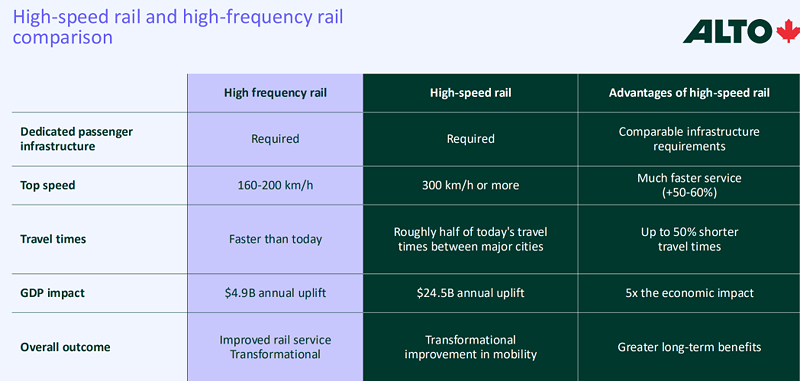
For a new rail service to be fast, reliable and frequent and generate the desired benefits, a new network is needed. And for it to generate the benefits that justify these efforts, frequency alone is not enough; travel times must also be significantly reduced. That’s what makes high-speed rail truly transformative, not only from a mobility perspective, but also for the economy as a whole. Thanks to Alto, travel times will be reduced by about 50%, providing a real alternative to cars and planes. High-speed rail will generate about five times more economic benefits than a high frequency train, with an estimated annual GDP increase of $24.5 billion, compared to $4.9 billion.
That is the choice made by some 20 countries that have invested heavily in passenger rail. France, which has been operating high-speed trains for 45 years, has just launched a new generation of high-speed trains. Morocco has also made this choice tosupport its economic developmentthrough improved mobility.
Concrete commitments to the agricultural community
However, Alto knows that the benefits of a linear project of this size do not allay the concerns of those who could be directly affected. Alto has heard the concerns of farmers and property owners who contribute to the economy and to the vitality of Quebec’s regions. It is precisely because Alto firmly believes in the importance of maintaining a strong agricultural community that it has made five concrete commitments:
- Limit impacts on agricultural land from the planning phase.
- Favour negotiated agreements with owners.
- Provide fair compensation that takes into account the long-term impacts on farms.
- Maintain agricultural access and community connections, including safe crossings.
- Support agricultural productivity and succession to contribute to the future of farms.
These commitments are at the heart of the project development.
Quote
“For people to truly choose rail, three conditions must be met: speed, frequency and affordability. But the project also needs to be developed in a way that takes into account the realities on the ground. Even though the UPA has chosen not to continue discussions with us, we will continue to reach out to farmers directly, as well as to all property owners and communities. Experience elsewhere in the world proves that high speed can coexist with agriculture. Several decisions remain to be made, and we want to continue working with the communities to find the best solutions, adapted to each one,” said Martin Imbleau, Alto’s President and CEO.
Relevant links:
- Economic Benefits Analysis: The-high-speed-train-an-economic-opportunity-for-canada-alto.pdf
- Public Consultation Report: June-2026 Public Consultation Report.pdf
- Alto’s commitments to rural and agricultural communities: Alto’s commitment to rural communities | Alto
- Acquisition Process: Our Property Acquisition Process | Alto
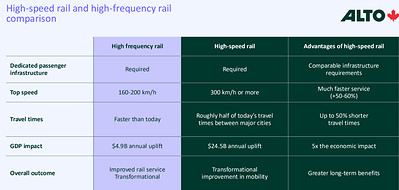
- HFR and HSR comparison:
ABOUT ALTO
Alto is a Crown corporation dedicated to building the largest public infrastructure project in Canada’s recent history – the country’s first ever, reliable and frequent high-speed rail network. With stations in Toronto, Peterborough, Ottawa, Montréal, Laval, Trois-Rivières and Québec City, this project will connect millions of Canadians living along the country’s most densely populated corridor. Alto will bring cities and people closer together and create significant socio-economic benefits that will help generations to come. For more information, please visit our website altotrain.ca.
SOURCE Alto
