



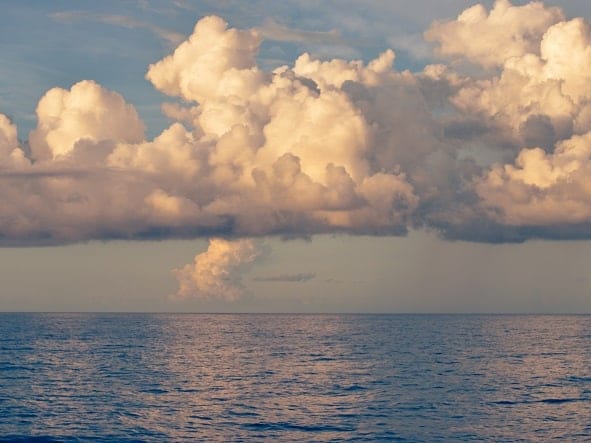
Climate change appears to have altered cloud coverage around the planet, causing a shift of mid-latitude storm tracks towards the North and South poles and compounding the effects of global warming.
Researchers at the Scripps Institution of Oceanography at the University of California San Diego analyzed satellite imaging during a 27-year period between 1983 and 2009 and discovered large-scale changes including poleward retreat of mid-latitude storm clouds, expansion of subtropical dry zones and increasing height of cloud tops into the atmosphere.
The findings are consistent with previous climate change simulations which predicted that as the planet warms and subtropic dry zones expand, cloud coverage would be pushed further north and south.
The study’s authors were able to conclude that the abrupt changes in cloud patterns are not a product of natural variabilities in weather patterns but instead a result of “external forcing” of the climate system by today’s phenomenon known as global warming. The research team compared cloud patterns over the past three decades with historical simulations dating to pre-industrial periods and found that no other 27-year period over the past 15,000 years exhibited a shift of this nature and magnitude.
“The primary drivers of these cloud changes appear to be increasing greenhouse gas concentrations and a recovery from volcanic radiative cooling,” say the study’s authors. “These results indicate that the cloud changes most consistently predicted by global climate models are currently occurring in nature.”
The primary and immediate consequence of these changes in cloud patterns is a further speeding up of the global warming process, say the scientists, whose new work appears in the journal Nature.
“The expansion of subtropical dry zones results in less reflection of solar radiation back to space,” say the authors. “And as cloud tops rise, their greenhouse effect becomes stronger. Both of these cloud changes have a warming effect on climate.”
The results add further insight into how weather patterns will continue to change during the 21st century, affecting countries and populations around the globe differently.
“This study is a big deal, both generally for climate change science, and also for understanding recent trends in regional hydroclimate,” says Jonathan Overpeck, co-director of the Institute of the Environment at the University of Arizona in Tucson. “The research highlights that there are winners and losers with global warming, and that the US Southwest is one of the losers when it comes to water generating storms moving north.”
Current projections stress the variability in global warming’s impact on different regions and populations around the globe, with the general scientific consensus being that climate change will widen the North-South gap and create further economic strife in much of Africa, Asia, South America and the Middle East. A 2015 study on the global economic effects of climate change states that while some of the more northerly countries like Russia, Mongolia and Canada will likely see upcoming benefits, up to three-quarters of the world’s nations will be more worse off than they are today.
Experts predict that Canada is heading into a period of greater weather variability, with both drought and extreme precipitation forecasted to become the norm.
About The Author /

Jayson is a writer, researcher and educator with a PhD in political philosophy from the University of Ottawa. His interests range from bioethics and innovations in the health sciences to governance, social justice and the history of ideas.


Comment
Leave a Reply
You must be logged in to post a comment.
RELATED POSTS
 Share
Share Tweet
Tweet Share
ShareTRENDING
All Trending →
TTNM keeps “Buy” rating at Haywood
March 20, 2024

NEO stock has price target chopped at Paradigm
March 18, 2024
Groupon’s turnaround is accelerating, Roth says
March 18, 2024
Cloud cover has change because of Persistent aircraft contrails .
Global warming Bullshit
Climate will do what climate will do as it has for hundreds of millions of years. Meanwhile, it is wise to base decisions and policy on hard fact.
Here are some crucial, verifiable facts – with citations – about human-generated carbon dioxide and its effect on global warming people need to know and understand. I recommend following the links in the citations; some of them are very educational. And please feel free to copy/paste this comment wherever you think it will do the most good.
The fact is, there has been global warming, but the contribution of human-generated carbon dioxide is necessarily so minuscule as to be nearly undetectable. Here’s why:
Carbon dioxide, considered the main vector for human-caused global warming, is some 0.038% of the atmosphere[1]- a trace gas. Water vapor varies from 0% to 4%[2], and should easily average 1% or more[3] near the Earth’s surface, where the greenhouse effect would be most important, and is about three times more effective[4] a greenhouse gas than carbon dioxide. So water vapor is at least 25 times more prevalent and three times more effective; that makes it at least 75 times more important to the greenhouse effect than carbon dioxide[5]. The TOTAL contribution of carbon dioxide to the greenhouse effect is therefore 0.013 or less. The total human contribution to atmospheric carbon dioxide since the start of the industrial revolution has been estimated at about 25%[6]. So humans’ carbon dioxide greenhouse effect is a quarter of 0.013, works out to about 0.00325. Total warming of the Earth by the greenhouse effect is widely accepted as about 33 degrees Centigrade, raising average temperature to 59 degrees Fahrenheit. So the contribution of anthropogenic carbon dioxide is less than 0.2 degrees Fahrenheit, or under 0.1 degree Centigrade. Global warming over the last century is thought by many to be 0.6 to 0.8 degrees Centigrade.
But that’s only the beginning. We’ve had global warming for more than 10,000 years, since the end of the last Ice Age, and there is evidence temperatures were actually somewhat warmer 9,000 years ago and again 4,500 to 8,000 years ago than they are today[7]. Whatever caused that, it was not human activity. It was not all those power plants and factories and SUVs being operated by Stone Age cavemen while chipping arrowheads out of bits of flint. Whatever the cause was, it melted the glaciers that in North America once extended south to Long Island and parts of New York City[8] into virtually complete disappearance (except for a few mountain remnants). That’s one big greenhouse effect! If we are still having global warming – and I suppose we could presume we are, given this 10,000 year history – it seems highly likely that it is still the overwhelmingly primary cause of continued warming, rather than our piddling 0.00325 contribution to the greenhouse effect.
Yet even that trend-continuation today needs to be proved. Evidence is that the Medieval Warm Period centered on the 1200s was somewhat warmer than we are now[9], and the climate was clearly colder in the Little Ice Age in the 1600s than it is now[10]. So we are within the range of normal up-and-down fluctuations without human greenhouse contributions that could be significant, or even measurable.
The principal scientists arguing for human-caused global warming have been demonstrably disingenuous[11], and now you can see why. They have proved they should not be trusted.
The idea that we should be spending hundreds of billions of dollars and hamstringing the economy of the entire world to reduce carbon dioxide emissions is beyond ludicrous in light of the facts above; it is insane. Furthermore, it sucks attention and resources from seeking the other sources of warming and from coping with climate change and its effects in realistic ways. The true motivation underlying the global warming movement is almost certainly ideological and political in nature, and I predict that
Anthropogenic Global Warming, as currently presented, will go down as the greatest fraud of all time. It makes Ponzi and Madoff look like pikers by comparison.
[1] Fundamentals of Physical Geography, 2nd Edition
by Michael Pidwirny Concentration varies slightly with the growing season in the northern hemisphere. HYPERLINK “http://www.physicalgeography.net/fundamentals/7a.html” http://www.physicalgeography.net/fundamentals/7a.html
[2] ibid.
[3] HALOE v2.0 Upper Tropospheric Water Vapor Climatology Claudette Ojo, Hampton University; et al.. HYPERLINK “http://vsgc.odu.edu/src/Conf09/UnderGrad%20Papers/Ojo%20-%20Paper.pdf” http://vsgc.odu.edu/src/Conf09/UnderGrad%20Papers/Ojo%20-%20Paper.pdf. See p. 4.The 0 – 4% range is widely accepted among most sources. This source is listed for its good discussion of the phenomena determining that range. An examination of a globe will show that tropical oceans (near high end of range) are far more extensive than the sum of the earth’s arctic and antarctic regions and tropical-zone deserts (all near the low end). Temperate zone oceans are far more extensive than temperate-zone desert. This author’s guess of an average of 2% or more seems plausible. I have used “1% or more” in an effort to err on the side of understatement.
[4 NIST Chemistry Webbook, Please compare the IR absorption spectra of water and carbon dioxide. ] HYPERLINK “http://webbook.nist.gov/” http://webbook.nist.gov/
[5] Three quarters of the atmosphere and virtually all water vapor are in the troposphere. Including all the atmosphere would change the ratios to about 20 times more prevalent and 60 times more effective. However, the greenhouse effect of high-altitude carbon dioxide on lower-altitude weather and the earth’s surface seems likely to be small if not nil.
[6] National Oceanographic and Atmospheric Administration. HYPERLINK “http://www.ncdc.noaa.gov/oa/climate/gases.html” http://www.ncdc.noaa.gov/oa/climate/gases.html. The estimated 90ppm increase in carbon dioxide, 30% above the base of 280 ppm, to a recent reading of 370 ppm, equates to just under 25% of present concentration, the relevant factor in estimating present contribution to the greenhouse effect.
[7] Oak Ridge National Laboratory http://www.esd.ornl.gov/projects/qen/nerc130k.html
[8] New York Nature – The nature and natural history of the New York City region. Betsy McCully http://www.newyorknature.net/IceAge.html
[9] Global Warming: A Geological Perspective John P. Bluemle HYPERLINK “https://www.dmr.nd.gov/ndgs/Newsletter/NL99W/PDF/globlwrmw99.pdf” http://www.azgs.az.gov/arizona_geology/archived_issues/Winter_1999.pdf This article, published by the National Oceanographic and Atmospheric Agency, is drawn from a paper by the author in Environmental Geosciences, 1999, Volume 6, Number 2, pp. 63-75. Note particularly the chart on p.4.
[10] Ibid.
[11] Wikileaks: Climatic Research Unit emails, data, models, 1996-2009 HYPERLINK “http://wikileaks.org/wiki/Climatic_Research_Unit_emails,_data,_models,_1996-2009” http://wikileaks.org/wiki/Climatic_Research_Unit_emails,_data,_models,_1996-2009.
See also HYPERLINK “http://www.dailymail.co.uk/news/article-1246661/New-scandal-Climate-Gate-scientists-accused-hiding-data-global-warming-sceptics.html” http://www.dailymail.co.uk/news/article-1246661/New-scandal-Climate-Gate-scientists-accused-hiding-data-global-warming-sceptics.html and
HYPERLINK “http://online.wsj.com/article/SB10001424052748704075604575356611173414140.html” http://online.wsj.com/article/SB10001424052748704075604575356611173414140.html and, more diplomatically: HYPERLINK “http://www.nytimes.com/2009/12/01/science/01tier.html” http://www.nytimes.com/2009/12/01/science/01tier.html. Et al.
ADDENDUM
What initially troubled me was the aberrant behavior of the climate research unit at East Anglia University, which had been the main data source for AGW arguments. They initially refused (!) to reveal their algorithms and data on the grounds that they were proprietary(!!). They responded to critics with ad hominem attacks and efforts to block their publication in scientific journals. Now, as I am sure you know, this is not how one does honest science, in which you PUBLISH your data and methodology and invite critical comment to ferret out error or oversights. It took the now-famous Wikileaks “Climategate” to pry loose the data and expose their machinations. Yet despite the devastating blow these revelations should have to their credibility, the AGW “cause” has taken on a life of its own.
Fundamentally, the argument seems to rest on a logical fallacy, post hoc ergo propter hoc – after this, therefore because of this. We see a rise in temperature and a rise in (principally) carbon dioxide, and therefore conclude one must have caused the other. It does not necessarily follow at all. There can be other causes entirely behind both phenomena, and as you see above, almost certainly there are. Beyond that, I have encountered numerous assertions of fact that cannot add up given the physical properties of water vapor and carbon dioxide that go unchallenged. One-sided arguments proliferate and people arguing the other side are frequently denounced as being employed by business interests rather than rebutted on the merits.
In sum, I have not come lightly to the conclusion that the AGW argument as it applies to carbon dioxide is largely untrue and certainly does not account for more than a very small, nearly negligible part of the phenomena we are seeing. The implications of widespread assertions of and belief in such an untruth are staggering, and potentially enormously destructive. It is unwise indeed to let oneself be stampeded in this matter, and stampede is clearly what many have been and are trying to induce.
I can understand politicians behaving this way; a carbon tax or carbon trading regime would allow enormous revenues to fall into their hands. I can understand “Progressive” ideologues; it logically leads to enormous expansion of government power over industry, the economy, and the daily life of individuals, which they regard as a good thing. I understand the environmentalists; they want to shrink the size and impact on the environment of modern civilization. But responsible citizens need to put aside such considerations.
Climate will do what climate will do…..over the eons past, that was a more or less accurate observation…..TODAY, Humans have become the PRIMARY FORCE affecting climate and the changes threatening our current level of civilization.
“… humans have known about anthropogenic (man made) global warming (AGW) for almost 200 years.
A National Geographic piece,Why Is the Man Who Predicted Climate Change Forgotten?, names Alexander von Humboldt (1769-1859) as a founding father of global warming science.
The
Guardian names George Perkins Marsh (1801-1882) as the author of “the
1847 lecture that predicted human-induced climate change.”
NASA likewise reminds us, “The heat-trapping nature of carbon dioxide and other gases was demonstrated in the mid-19th century.”
I have Searched and Searched and have not found Al Gores Signature on these Seminal Research reports/ lectures.
“Despite
the apparent inability of many of our current policy makers to accept
the scientific reality of climate change, the science is not new.
Fifty-nine years ago, on Oct. 28, 1956, the New York Times ran a story in their Science in Review section entitled ‘Warmer climate on the earth may be due to more carbon dioxide in the air.’”
The Legitimate Scientific Community issued a report & warning to President Eisenhower in 1958.
The Legitimate Scientific Community issued a research report & warning to President Johnson in 11/5/1965.
Another Warning:
When
entire forests were browning and dying, the legitimate
scientific community reported that tiny amounts of INDUSTRIAL waste
Gasses & Chemicals were being disposed of by unrestrained pumping into the
atmosphere.
A conservative President with science, took quick precise action ….those forests have been replanted.
Another Warning:
Near
epidemics of skin cancers around the globe, were examined by the
Legitimate scientific community, and found the Industrial/Commerical
Gasses and Chemicals
were being pumped into our atmosphere.
Another Conservative President took quick efficient action and last month we learned that the ZONE HOLE
has shrunk by 20%.!
CO2 and other fossil fuel waste products have been pumped into the atmosphere in FAR LARGER massive quantities than
the Gasses & Chemicals we already LEARNED can damage the atmosphere and the world’s environment.
Today, the Threat is Apparent.
*
*****The Last 20 Years have been the HOTTEST 20 Year Period in history.
When
Legitimate Science examined in detail, proxy measures like ice cores
around the world, we learn that the last 20 YEARS HAS BEEN the HOTTESTIN
Thousands of years.
Temps are rising, ocean levels are rising and surface areas increase.Between the added heat and moisture to our atmosphere……
.
*World Wide Storms have doubled.
*Storm intensity has nearly doubled.
*Heat waves have nearly doubled.
*Droughts have doubled.
*Flooding events have doubled.
*Asian
News Media is in near panic mode as their populations are watching
yearby year, snow packs and glaciers decrease…..visibly decrease. That
is their PRIMARY source of water for drinking and irrigation.
*The
Earth’s 270 Largest fresh water lakes are warming at twice the
atmospheric temperature rise….leading to increased algae Blooms and
fish die offs.
*10 of the 15 busiest hurricane seasons have occurred since 2000.
*The World’s strongest Hurricane occurred just last year.
*Just Last year 3 SUPER TYPHOONS occurred as the same time.
In the early 20th century about 6 towns or cities had some tidal flooding.
**…TODAY,
dozens of US towns & cities have routine Tidal/Storm flooding.
….you can watch Norfolk, Virginia flood on YouTube.
Miami and New York are spending large amounts of money in preparation of sea rise and storm surges.
TRILLIONS of Dollars of US infrastructure lie less than 3 feet or so, of sea level, our ports and port cities, many power grids, highways, etc.
.
“…The
Arctic is experiencing a heat wave. Alaska reached temperatures in the
80s, with Deadhorse reaching a record-high temperature of 85 degrees on
Wednesday evening. Other cities including Bettles and Eagle reached 85,
Fort Yukon hit 84, and Nenana reported 87.
“A pulse of warm air
invaded
the North Slope of northern Alaska on Wednesday, bringing some of the
warmest air ever recorded there,” meteorologist Jeff Masters explained
on his blog, Weather Underground.
“Even with the
24-hour sunlight it receives during most of July, the North Slope
typically experiences highs only in the 50s and lows in the 30s.”
*Fairbanks also officially reported 87, but one record showed Fairbanks’ airport reaching 96 degrees Wednesday.
Meanwhile hundreds of miles south in Orlando, Fl.,
temperatures
reached 94 degrees, according to the National Weather Service. Miami
and Daytona Beach only rose to 92 on Wednesday.Temperatures in Fairbanks
could reach 90 degrees on Thursday or Friday, National Weather Service
meteorologist Rick Thoman reported to the Alaska Dispatch News…..”
***Even
the Bugs know what is going on in this world……The Lowly pine
Beetle, for thousands of years confined to southern warm
climates….can NOW BE FOUND IN FAIRBANKS, ALASKA.
Those Green House Gasses have been studied for 150 years..Those tiny amounts, you refer to, is why science, for over a decade have CALLED the TRACE GASSES.
If you had any high school chemistry….you would know about Catalyst…
when truly tiny tiny amounts of a catalyst is put into another much much larger quantity of liquid it CAUSES HUGE CHANGES……..tiny quantities can have huge consequences.
and YES water vapor works hand in hand with greenhouse gasses to warm our atmosphere.
The rest of your rant has been repeatedly refuted in nearly every College Science course for decades and decades.
and, Yes!,
we have been in an inter-Glacial Warming for several thousands years….until about 5 or 6 hundred years ago……then we started a long slow slide of steadily cooler temperatures around the world….as we entered the next REAL ICE AGE.
…Then, with humans cutting down tens of millions of trees to stay warm
and
digging up tens of millions of tons of coal, to stay warm.
…the onset of the 1st industrial revolution….all that Carbon Dioxide entering the atmosphere and other environmental changes…..1st blunted the slide into the next real ice age.
…Then ended it.
That Period is now called the “LITTLE ICE AGE”
In spits and spurts and sputters…temperatures world wide have been going up since !
Childish nonsense.
YEP>>>>
in 1910, when Montana’s Glacier National Park was made a national park…..there were 150 pristine glaciers.
in the 1950’s when I was there, there were 150 Glaciers.
All
that
Global Warming Bullsh.t….melted 125………POOOOF ! ….only 25 remain.
And according to the Deniers, we are slipping into the next real ice age….we will be knee deep into it, by 2030.
How do you melt Glacier Ice without 100 DEGREE Bull Sh.T !!
.
Oh, have you noticed that we have not set 1 (not one) Record World Cold Year….since 1911 ?
I invite interested readers to read the original comment and judge for themselves.
I believe it is worth the trouble.
“… humans have known about anthropogenic (man made) global warming (AGW) for almost 200 years.
A National Geographic piece,Why Is the Man Who Predicted Climate Change Forgotten?, names Alexander von Humboldt (1769-1859) as a founding father of global warming science.
The
Guardian names George Perkins Marsh (1801-1882) as the author of “the
1847 lecture that predicted human-induced climate change.”
NASA likewise reminds us, “The heat-trapping nature of carbon dioxide and other gases was demonstrated in the mid-19th century.”
I have Searched and Searched and have not found Al Gores Signature on these Seminal Research reports/ lectures.
“Despite
the apparent inability of many of our current policy makers to accept
the scientific reality of climate change, the science is not
new.
Fifty-nine years ago, on Oct. 28, 1956, the New York Times
ran a story in their Science in Review section entitled ‘Warmer climate
on the earth may be due to more carbon dioxide in the air.’”
The Legitimate Scientific Community issued a report & warning to President Eisenhower in 1958.
The Legitimate Scientific Community issued a research report & warning to President Johnson in 11/5/1965.
Another Warning:
When
entire forests were browning & dying, the legitimate
scientific community reported that tiny amounts of INDUSTRIAL waste
Gasses & Chemicals were being disposed by pumping into the
atmosphere.
A conservative President with science, took quick precise action .
…those forests have been replanted.
Another Warning:
Near
epidemics of skin cancers around the globe, were examined by the
Legitimate scientific community, and found the Industrial/Commerical
Gasses and Chemicals
were being pumped into our atmosphere.
Another Conservative President took quick efficient action and last month we learned that the ZONE HOLE
has shrunk by 20%.!
CO2 and other fossil fuel waste products have been pumped into the atmosphere in FAR LARGER massive quantities than
the Gasses & Chemicals we already LEARNED can damage the atmosphere
and the world’s environment.
Today, the Threat is Apparent.
*
*****The Last 20 Years have been the HOTTEST 20 Year Period in history.
When
Legitimate Science examined in detail, proxy measures like ice cores
around the world, we learn that the last 20 YEARS HAS BEEN the HOTTESTIN
Thousands of years.
Temps are rising, ocean levels are rising and surface areas increase.Between the added heat and moisture to our atmosphere……
.
*World Wide Storms have doubled.
*Storm intensity has nearly doubled.
*Heat waves have nearly doubled.
*Droughts have doubled.
*Flooding events have doubled.
*Asian
News Media is in near panic mode as their populations are watching
yearby year, snow packs and glaciers decrease…..visibly decrease. That
is their PRIMARY source of water for drinking and irrigation.
*The
Earth’s 270 Largest fresh water lakes are warming at twice the
atmospheric temperature rise….leading to increased algae Blooms and
fish die offs.
A very large lake in Utah is suffering with Algae bloom, sickened swimmers and dead fish. this last WEEK !
.
*10 of the 15 busiest hurricane seasons have occurred since 2000.
*The World’s strongest Hurricane occurred just last year.
*Last year 3 SUPER TYPHOONS occurred as the same time.
*The Strongest Super Cyclone hit Figi last year.
In the early 20th century
about 6 towns or cities had some tidal flooding.
**…TODAY,
dozens of US towns & cities have routine Tidal / Storm flooding.
….you can watch Norfolk, Virginia flooding on YouTube.
Miami and New York are spending large amounts of money in preparation of sea rise and storm surges.
TRILLIONS of Dollars of US infrastructure lie less than 3 feet or so, of sea level:
ALL our ports & port cities, many power grids, highways, Prime Farm Land, etc.
.
“…The
Arctic is experiencing a heat wave. Alaska reached temperatures in the
80s, with Deadhorse reaching a record-high temperature of 85 degrees on
Wednesday evening. Other cities including Bettles and Eagle reached 85,
Fort Yukon hit 84, and Nenana reported 87.
….
“Even with the
24-hour sunlight it receives during most of July, the North Slope
typically experiences highs only in the 50s and lows in the 30s.”
*Fairbanks also officially reported 87, but one record showed Fairbanks’ airport reaching 96 degrees Wednesday.
Meanwhile hundreds of miles south in Orlando, Fl.,
temperatures
reached 94 degrees, according to the National Weather Service. Miami
and Daytona Beach only rose to 92 on Wednesday.Temperatures in Fairbanks
could reach 90 degrees on Thursday or Friday, National Weather Service
meteorologist Rick Thoman reported to the Alaska Dispatch News…..”
***Even
the Bugs know what is going on in this world……The Lowly pine Beetle, for thousands of years confined to southern warm climates..can NOW BE FOUND IN FAIRBANKS, ALASKA.
really ?
I can see why DiogenesDespairs….
he hasn’t read the detail Satellite Measures of Global Warming…..
4 nations have satellites:
They read incoming SOLAR RADIATION ENERGY….nearly all invisible to our atmosphere.
They read out going Earth Radiation Energy…………….Detail measures as Green House Gasses have increased in our atmosphere, in those EXACT WAVELENGTHS that Green House Gasses work, EARTH RADIATION Energy is missing…not escaping Earth…..
THAT captured Energy is reflected in all directions with a large chunk of it right back to earth as heat.
THAT is global warming.