
Queen’s University Human Media Lab to unveil flexible 3D smartphone display

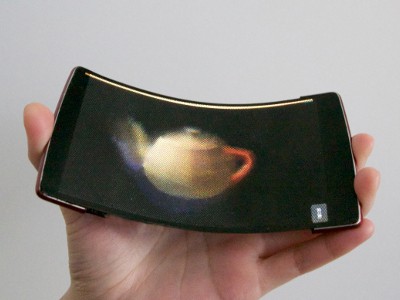
Researchers at Queen’s University’s Human Media Lab will be unveiling HoloFlex, the world’s first “holographic” flexible smartphone, at ACM CHI 2016, a Computer-Human Interface conference staged by the Association for Computing Machinery, on May 9 in San Jose, California.
The HoloFlex uses a 1920×1080 full high-definition Flexible Organic Light Emitting Diode (FOLED) touchscreen display, which provides viewers with a wide-angle view of a 3D object from different viewpoints.
“HoloFlex offers a completely new way of interacting with your smartphone. It allows for glasses-free interactions with 3D video and images in a way that does not encumber the user,” said Dr. Roel Vertegaal, Professor of HCI at Queen’s School of Computing and director of the Human Media Lab.
A 3D image is rendered into 12-pixel wide circular blocks, which project through a 3D-printed flexible microlens array that consists of 16,640 fisheye lenses, resulting in a glasses-free 106×104 resolution image that uses motion parallax and stereoscopy to create a “holographic” image that can be viewed by multiple users from any angle by rotating the phone.
“By employing a depth camera, users can also perform holographic video conferences with one another,” said Dr. Vertegaal. “When bending the display users literally pop out of the screen and can even look around each other, with their faces rendered correctly from any angle to any onlooker.”
That limited resolution, of course, is what makes it clear that this remains a research project, with massive potential for commercialization when the researchers can figure out how to improve the pixelated look of a 106×104 3D image on a 1080p smartphone screen.
Among the many uses for the technology foreseen by its developers are 3D teleconferencing, holographic gaming, and the creation and editing of 3D models.
Research for the HoloFlex was supported by Immersion Canada Inc. and the Natural Sciences and Engineering Research Council of Canada (NSERC).
In February, the Human Media Lab announced its ReFlex flexible smartphone, a full-colour, high-resolution and wireless flexible smartphone powered by a 1.5 GHz Qualcomm Snapdragon 810 processor and 2 GB of memory, which also features a bend sensor, enabling the user to move objects along the z-axis of the display by bending the phone.
The Human Media Lab has previously invented ubiquitous eye tracking sensors, eye tracking TVs and cellphones, a flexible phone called PaperPhone, a flexible iPad called PaperTab, and a pseudo-holographic teleconferencing system called TeleHuman.
Terry Dawes
Writer