
Are bike helmets safe? Yes, but here’s what really makes cycling safer

Are bike helmets safe?
Last year, Radio-Canada journalist Isabelle Richer was hit by a car while riding her bicycle in rural Quebec, a life-threatening collision that broke several vertebrae, briefly put her in a coma and kept her hospitalized for three weeks. The crash also shattered her bike helmet.
Now, some nine months later, much improved but still dealing with post-concussion symptoms, Richer is acting as spokesperson for Défi Tête La Première, a 500-kilometre charity ride aimed at raising funds to buy 750 helmets for children and at bringing awareness to the importance of wearing bike helmets.
“There is no way I would go onto a bike now without one, now that it saved my life,” Richer said in an interview for the Montreal Gazette.
The research on the effectiveness of helmets is not straightforward, however. Every year in Canada about 7,500 cyclists suffer serious injuries and in 2007, the last year for which statistics are available, 65 cyclists died in traffic collisions, representing 2.3 per cent of all road fatalities.
While studies have confirmed that among those injured in cycling crashes, the odds of head, brain or face injuries are significantly lower for people who wear helmets, there does not appear to be a similar effect of helmet on bicycle collision fatalities. For instance, a Transport Canada report compared data for cycling deaths between 1975 and 1987, when helmet use was minimal, to cycling deaths between 1988 and 2002, when helmet use became more popular (and in some provinces, mandatory). It turned out that the number of fatalities has remained fairly constant over these periods, suggesting that helmet use has not reduced the number of fatalities.
Along with the concerns over fatalities, governments and policy-makers have another issue to consider: studies have shown that on its own, making helmet use mandatory does not have a significant effect on injuries to cyclists and hospitalization rates for bicycle injury are not influenced by mandatory helmet legislation.
What does seem to make a difference is infrastructure and mass numbers of cyclists. In places where the proportion of people using bicycles for transportation is high, the rates of injury and fatalities is lower. And in regions where bike-specific infrastructure is in place (dedicated bike lanes, for instance) the rates of injury and fatalities are also lower.
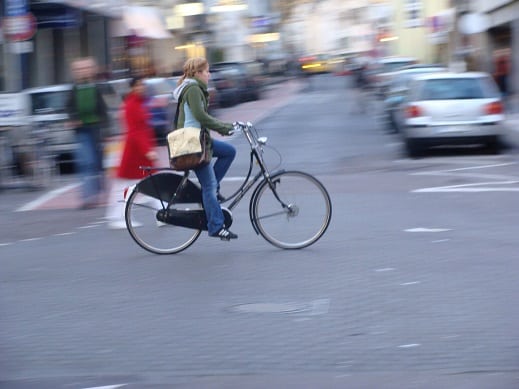
In countries like the Netherlands, Denmark and Germany, where cycling is more of a way of life (an estimated 10 to 27 per cent of trips are made by bicycle in these countries) helmet use turns out to be rare, yet injury and fatality rates are many times lower than those in Canada and the United States.
Cultural differences -such as a general valuing of bike culture over car culture- may account for some of the differences between the Northern European countries and North American in terms of bicycle collision statistics, but it is also evident that governments that invest in bicycle infrastructure not only help to perpetuate bike culture and bike safety but they save lives.
Germany, for example, has begun building an “Autobahn for bikes” and Norway has just announced plans for a $1 billion (USD) investment in bicycle superhighways to connect nine of its cities with their respective suburbs.