



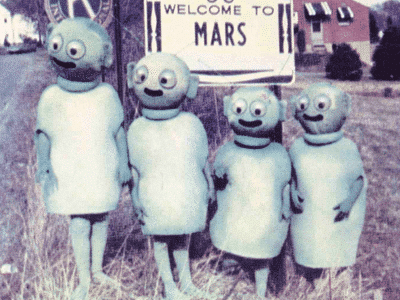
Astronaut Julie Payette poured cold water on the hopes of potential Mars astronauts, speaking to a gathering on Wednesday at the International Civil Aviation Organization’s headquarters in Montreal. “Nobody is going anywhere in 10 years,” she said.
Payette has been to space twice, in 1999 and 2009, and is now chief operating officer at the Montreal Science Centre.
Aside from calling into question our capacity for actually getting to Mars at all, Payette took a swipe at Mars One, a Dutch project that has signed up a significant, if unclear, number of people willing to take the journey and establish a foothold on the Red Planet within 10 years.
“We don’t have the technology to go to Mars, with everything we know today, so I don’t think that a marketing company and a TV-type of selection is sending anybody anywhere,” she said, adding, “So if you meet any of those people, don’t tell them they’re courageous, because the only courage they had was to sign up on a website.”
For the better part of a year, Mars One had the benefit of the doubt from the world’s media, getting good exposure owing to the stories of willing participants who would do what it took to be first inhabitants of a permanent base on Mars.
Stating that its ambition was to establish a colony on Mars by 2025 at a mission cost of $6 billion, Mars One still has six Canadians remaining among a long list of 100 applicants still in the running.
But recent claims, from both logistical and ethical standpoints, have called into doubt whether Mars One ever intended to get off the ground.
American Mars hopefuls paid a $38 admission fee, while Mexicans paid $15. The fee is adjusted according to each nation’s GDP.
The Mars One organization has three paid employees, including CEO Bas Lansdorp.
Mars One claims to have had 200,000 applicants for the Mars mission. This number hasn’t been verified, though it has been repeated widely as fact.
For three paid staff to wade through 200,000 applications for a credible space mission and still run the marketing and fundraising end of their business, not to mention the pesky unresolved details around scientific hardware, stretches belief a little thin.
Mars One’s chief medical officer told the Guardian that he was processing 80,000 applications. NBC news estimated total applications to Mars One at 2,782 after counting video essays that candidates were required to upload.
Set your watch. Class action lawsuit to reclaim those applications fees lifting off in 10, 9, 8…
“How does a space suit on Mars work? Show me how it is pressurized, and how it is cooled. What’s the glove design? None of that stuff can be bought off the rack. It does not exist. You can’t just go to SpaceMart and buy those things.” – Chris Hadfield
Melissa Ede, one of 23 U.K. applicants, had to organize her own medical evaluation which she paid for out of pocket. Ede told Newsweek that she has yet to meet a representative from Mars One and that her next interview will be via Skype.
In a “tips for candidates” document distributed in February, Mars One instructed applicants, “We do kindly ask for you to donate 75 per cent of your profit to Mars One,” referring to any speaker fees or media appearances that the Mars hopefuls might squeeze out of the public interest associated with the mission.
One clue that Mars One is less than savory might have come from the fact that their revenue source outside of “crowd-funding”, advertising revenue and “private investors” was that the whole thing would be wrapped up in a reality show.
That’ll be fun, watching four people die on live television, after we’ve seen them flying through space for almost a year, arguing with each other while the producers back on Earth invent phony personal dramas to help improve ratings and keep the show interesting.
This is after, of course, the 10-year “training camp” that will all be filmed and broadcast in the run-up to lift-off. Riveting television, for the ethically challenged.
Mars One estimates that they’ll be able to sell TV rights for $8 billion. This figure, even if it were hinged in any kind of reality, is probably more untenable than the mission itself.
The Mars One IndieGogo campaign raised $313,744 of its $400,000 target. Again, not a bad haul for something that will never happen. And not a bad cut for IndieGogo, at 9% for a failed campaign.
Hearing Mars One describe it, at least on their website, skepticism about the mission speaks to a lack of imagination or willingness to take risk.
But it’s right to be skeptical of a mission that is so clearly an attempt to goose public optimism for marketing and PR purposes, playing on the hopes and insecurities of people who want nothing more than to believe in a great cause, or, to put it less charitably, to become famous.
The Mars One mission is not a JFK moment for humanity. JFK had NASA at his disposal, and the Cold War to fuel a competitive mission to beat the Soviet Union to the moon.
We’re going because we want to be famous.
Let’s turn to the grown-ups now, like Julie Payette and a few other people who are actually in a position to know what they’re talking about, for a little perspective.
Chris Hadfield cautioned, in an interview for a Medium article regarding Mars One, “I really counsel every single one of the people who is interested in Mars One, whenever they ask me about it, to start asking the hard questions now. I want to see the technical specifications of the vehicle that is orbiting Earth. I want to know: How does a space suit on Mars work? Show me how it is pressurized, and how it is cooled. What’s the glove design? None of that stuff can be bought off the rack. It does not exist. You can’t just go to SpaceMart and buy those things.”
If there’s a person alive who knows anything about the physical human limits of space travel, it’s Chris Hadfield, who has spent a total of 166 days in orbit on three separate missions. He was incapable of standing up in a shower after he returned to Earth, so great is the toll of space travel.
The record holder for time in space is Valery Polyakov, who spent 437 days on the MIR space station in the 1990s. He exercised two hours a day, just to mitigate the physical deterioration and bone density loss that happens in zero gravity.
Another cosmonaut, Valentin Lebedev, lost his eyesight to cataracts provoked by elevated radiation levels during his 211 days in orbit in 1982.
 It will apparently take between seven and nine months to get to Mars, and then the Martian colonists will be living at 38% Earth’s gravity, permanently.
If the four Mars One colonists arrive alive and manage to set up a camp, they’ll have a two-year wait until the next four astronauts arrive. They’ll need food and water, with no Martian water that we know of yet.
Last autumn, four MIT students presented “An Independent Assessment of the Feasibility of the Mars One Mission Plan” at the International Astronautical Congress in Toronto.
In their detailed analysis of what would actually be required to set up a rudimentary method of growing food on Mars, the students called into doubt the practical reality of Mars One’s numbers. Their more likely scenario is that the astronauts would asphyxiate in the process of attempting to grow the food.
Given that it cost $2.74 billion to send the Curiosity Rover, a space laboratory the size of a hatchback, it seems dubious at best to claim to be able to send a manned spacecraft to Mars 10 years from now for only twice that budget.
On the Mars One website, the technological specifications about the trip specify the use of third-party private operators. “Mars One anticipates using Space X Falcon Heavy, an upgraded version of the Falcon 9, which is in use by Space X currently. The Falcon Heavy is slated to undergo test flights in 2014, granting ample time for fine-tuning prior to the Mars One missions.”
This is the same Falcon 9 rocket that blew up in the skies over Texas last August. That represents a setback for Elon Musk, but he’s likely to try again after they work out the kinks. SpaceX, however, has no ongoing contracts with Mars One and has denied involvement.
Elon Musk has talked about how cool it would be to die on Mars. “SpaceX is only 12 years old now,” he said to Aeon in September. “Between now and 2040, the company’s lifespan will have tripled. If we have linear improvement in technology, as opposed to logarithmic, then we should have a significant base on Mars, perhaps with thousands or tens of thousands of people.”
Given his successes with Tesla and, barring the occasional explosion, SpaceX, you’d think if anyone outside of NASA could get us there, it would be Musk. But he has a fairly realistic grasp of the challenges.
“Excluding organic growth, if you could take 100 people at a time, you would need 10,000 trips to get to a million people,” he said. “But you would also need a lot of cargo to support those people. In fact, your cargo to person ratio is going to be quite high. It would probably be 10 cargo trips for every human trip, so more like 100,000 trips. And we’re talking 100,000 trips of a giant spaceship.”
Musk’s credibility is also helped by the fact that he is not motivated by the need to create a reality TV show to help fund the mission.
“We don’t have the technology to go to Mars, with everything we know today, so I don’t think that a marketing company and a TV-type of selection is sending anybody anywhere.” – Julie Payette
Gerard ‘t Hooft, a theoretical physicist at Utrecht University, Nobel laureate and early supporter of Mars One, told the Guardian in February, “When they first asked me to be involved I told them ‘you have to put a zero after everything’, implying that a launch date 100 years from now with a budget of tens of billions of dollars would be an achievable goal, adding, ‘People don’t want something 100 years from now.'”
Yes, Mars is in our future, most likely, but as Julie Payette put it none too gently, “nobody is going anywhere in 10 years.”
We haven’t been back to the moon since 1972. How can we talk about going to Mars when we don’t even have a base on the moon yet?
As Chris Hadfield points out, the moon is where we need to test the possibility of life on another “planet” before we can even think about repeating the process on Mars.
“We absolutely need to do it on the moon for a few generations, learn how to do all of those things — how do you completely recycle your water? How do you completely recycle your oxygen system? How do you protect yourselves from radiation? How do you not go crazy? How do you set up the politics of the place and the command structure, so that when we get it wrong we won’t all die? How do we figure all that out?”
What’s clear at this point is that the brains behind Mars One are not the people who are going to “figure all that out”. They can’t even run an IndieGogo campaign.
“It’s not a race, it’s not an entertainment event,” continues Hadfield. “We didn’t explore the world to entertain other people. We did it as a natural extension of human curiosity and matching capability. And that’s what will continue to drive us.”
 On Halloween in 1938, Orson Welles broadcast an adaptation of H.G. Wells’ War of the Worlds, presenting a Martian invasion as if it were a news broadcast interrupting a program of light music. Panic ensued. For all anyone knew at the time, the black lines visible on Mars from Earth were the roadways or canals of a great civilization. We didn’t know anything about Mars.
FCC Chairman Frank P. McNinch launched an investigation into the broadcast, saying, “The widespread public reaction to this broadcast, as indicated by the press, is another demonstration of the power and force of radio and points out again the serious public responsibility of those who are licensed to operate the station.”
Mars One has, for the past couple years, had a pretty good ride out of the media. It’s an inspiring story, going to Mars. People want to believe, and doubters can be dismissed on the basis that they’re just not dreaming hard enough.
Mars One CEO Bas Lansdorp seems to have already resigned himself to being a footnote in history, saying, “Even if we don’t make it, I’m sure we will inspire other people who can.”
Have you ever felt inspired by a reality show? Or have you generally felt afterwards like something had been taken away from you?
Probably the best outcome from the Mars One fiasco is that we as a species will have to face up to the reality that space travel is difficult and expensive and probably can’t be accomplished through crowd-funding or the extraterrestrial equivalent of Uber.
Maybe we’ll have to learn to accept that the planet we evolved to be alive on is Earth and to finally begin treating it well enough to keep us alive into the indefinite future, instead of blowing it off for the first inhospitable rock that catches our eye now that we’re so bored with Earth.
In the meantime, enjoy this trailer from Brian De Palma’s film Mission to Mars. It’s as close as you’re ever going to get.
About The Author /



Comment
Leave a Reply
You must be logged in to post a comment.
RELATED POSTS

 Share
Share Tweet
Tweet Share
ShareTRENDING
All Trending →
TTNM keeps “Buy” rating at Haywood
March 20, 2024

NEO stock has price target chopped at Paradigm
March 18, 2024
Groupon’s turnaround is accelerating, Roth says
March 18, 2024
People want fantasy, not reality. Why not put all this energy and money and organization into fixing some of this world’s problems – like helping people who can’t get clean water, decent housing, etc… on this planet??? I guess that’s not nearly as fun. Very good article, by the way.
Perhaps with her attitude we might never have reached the moon.
Please inform us as to how you’re going to get through the Van Allen radiation belt surrounding the earth. While you’re at it, explain how the moon guys did it.
I guess it must be true if she said it, apparently she knows!
No. It’s her attitude that got folks to the moon and back!
The answers to the questions you pose may well come from such ventures as the space programs of the worlds nations. Remember that not one of those programs sent any money into space. They all spent billions here, on people here, developing systems and answering questions such as you have posed. It is through things like the space programs that we learn the science required to answer the questions that you ask. There are few if any modern devices in use today, that do not in someway benefit or were made possible by technology developed as a result of a Space program.
Until now, I have studiously avoided reading anything about Mars One, because it just seemed so inconsequential and out of the mainstream, but now I think we need to examine its bona-fides, whether it’s not a scam. I recall people buying patches of the Moon when I was a child …
first of 4 Astronaut land safe on Mars, happy as can be hugs and handshakes go around , 10 minutes later it dawned on them .
something they never thought about back home ! …. No pubs , no Movie theaters , No strippers , no grabbing the morning paper in your underwear absolutely nothing but a life off looking at the same 4 people till you die (most married people struggle to get to 5 years) all you got is a shovel and a life of turning over rocks and drinking recycled urine.
There was no reason to go to the Moon either; the motive was also fame, but national fame; people were supposed to subsume their identity into their nation, gripped in conflict with another ideology for domination of the world, the solar system, the galaxy! The Venusians didn’t even know the commies were coming, or that NASA would save them first. The universe is lucky to have us, etc.
Going to the moon was a failure; defining the terms of success as “dude walks on surface” or any other self-aggrandisement doesn’t change that. The distractions have kept coming since then.
tin foil ! lol
There is not and never was any plan to send these people to Mars. The only plan is to make a reality TV show about the process, and the purpose of this is to make money for the producers.
In order to maintain interest, they continue to perpetuate the idea that they do intend to go to Mars. Would you watch the show knowing they aren’t going? Personally, I won’t be watching.
If they send people to Mars to die, I’ll eat my hat.
My opinion, exactly! Ten years is a long time, in terms of possible advancements in technology. Besides, I don’t like her attitude.
The way to get people interested in space is to raise awareness that it isn’t some ultra-rare, super-expensive, impractical privilege to get there, and that things that happen there are interesting and relevant to the average person.
The way to get businesses interested in space is to demonstrate that there is a market for space-related stuff & services, and a way to make money.
In so far as a reality show does both, it is brilliant.
Before Mars One, Elon Musk mentioned mars colonies in off-hand remarks, with engineered casualness — maybe because folks would call him a kook for wanting a colony before 2050. Before Mars One, nobody talked about wanting to go there in any serious way — if all that comes out of this is the fact that the public psyche now accepts that a self-sustaining mars colony is possible and desirable, then Mars One is a win.
It only allows for people to walk away with other people’s money.
And yes, they are laughing all the way to the bank.
It is painful that there are people dumb enough to give these scam artists money.
I’m going to start an offshore account for people to contribute to the goal of a one way trip to Tatooine. The more money you give me results in a better selection process.
In current funds it took approximately 110 billion present day dollars and all of NASA to get a handful of people to go on a 1 week excursion to the Moon.
We will be lucky to EVER go to Mars using a significant resources by the ESA and NASA. Some boneheads passing around a donation hat, ain’t going to cut it
Over the course of the lunar missions, astronauts were exposed to doses lower than the yearly 5 rem average experienced by workers with the Atomic Energy Commission who regularly deal with radioactive materials.
Your kid gets a LOT more from his or her cell phone when initiating a call with the phone jammed against their head.
Possibly. But one thing is certain. If we don’t try we won’t get there. That was my point.
Author hasn’t done their research, just a biased hate article.
You are accusing Mars One of criminal activity; fraud. That accusation has yet to be shown to have merit, and might be libelous — so let us leave what other folks’ motives and intent might be to the judicial system.
It also seems petty to say such things as “So if you meet any of those people, don’t tell them they’re courageous, because the only courage they had was to sign up on a website.” and “We’re going because we want to be famous.” It is one thing to criticize the Mars One organizers for mistakes… but these kind of statements about the volunteers are a new kind of shitty.
The vision competing with Mars One, the thing which is supposed to be the shape of space exploration to come? It seems hopeless and dismal: “In the meantime, enjoy this trailer from Brian De Palma’s film Mission to Mars. It’s as close as you’re ever going to get.” and “When they first asked me to be involved I told them ‘you have to put a zero after everything’, implying that a launch date 100 years from now with a budget of tens of billions of dollars would be an achievable goal, adding, ‘People don’t want something 100 years from now.’” and “Julie Payette put it none too gently, “nobody is going anywhere in 10 years.”
Hell, with that kind of vision, why bother? That isn’t a vision for space exploration, it is a vision of despair and defeat.
You seem to feel strongly that Mars One will fail; and they might.
But
whether they fail or not isn’t what the meat of my argument is about —
it is that they have made the idea of settling on mars mainstream and
acceptable. Millions of folks around the world have heard of the Mars
One plan, and know that many thousands of people have volunteered for a one way trip.
The
only widespread vision before this was “let us wait until much later
sometime, and maybe a hugely expensive government mission will send a few
ultra-elite folks to plant a flag and come back”. In relation to that,
Mars One has performed a great service — today mars is more relevant
and exciting than it was.
So, in conclusion, I’m not going to have to eat my hat because these people aren’t going to Mars.
…there is some doubt that anyone has been to the Moon, let alone go to Mars!
I shouldn’t do this as it breaks the “Don’t Feed The Troll” rule of the internet but I’m sleepy and my judgement is impaired.
Please ignore this well-written article from Popular Science that I’m sure you will dismiss once your confirmation bias kicks in since it’s not from some conspiracy theory site that you wrote and/or subscribe to.
http://www.popsci.com/blog-network/vintage-space/apollo-rocketed-through-van-allen-belts
Telling these future astronauts/nuts that space is only in their dreams is very much like teaching pigs to sing. Mars is just a good place to park a ROVER. The world has too many idiots and it could be cost effective to send them to Mars. Maybe NASA has already figured this out and has a master plan in the works. PS. I hope they start soon….
Actually you get no (zero, none, nada) ionizing radiation from cell phones, jammed against your head or otherwise. They cannot cause cancer. We don’t think so, we don’t suppose so, we KNOW so!
Cancer is caused by damage to DNA. Cell phones emit radio waves, not the kind of radiation emitted from radioactive materiel. That means that the frequencies of the radio waves emitted by cell phones are not the kind of frequencies that damage DNA.